4WD vs AWD: How Four-Wheel-Drive Systems Work in Pickups
Part-time, full-time, automatic 4WD and crossover-style AWD all put power to four tires. Here's how each one does it, where each one runs out of talent, and which one fits your driving.
The short version
- Part-time 4WD locks the front and rear driveshafts together, so it belongs on slick or loose surfaces, never dry pavement.
- Full-time 4WD adds a center differential so it can run on any surface. Locking that center diff makes it act like part-time.
- Automatic modes like Ford's 4A and GM's Auto 4WD use a clutch pack in the transfer case to send torque forward as needed.
- Crossover-style AWD pickups such as the Ridgeline, Maverick and Santa Cruz have no low range for slow, steep work.
- 4WD only solves front-to-rear traction. Side-to-side traction is the job of traction control and locking differentials.
Four-wheel drive and all-wheel drive both send power to all four tires, but they get there in very different ways, and those differences decide what your truck can do on a slick boat ramp, a snowy interstate or a rocky shelf road. Here's how each system works, what the knob on your dash actually changes, and which layout makes sense for the way you drive.
The problem every 4x4 system has to solve
When a truck turns, all four tires travel different distances. The front tires swing through a wider arc than the rears, so the front driveshaft wants to spin a little faster than the rear one. Each axle's differential takes care of the left-to-right difference. The front-to-rear difference is the transfer case's problem.
If the transfer case ties the front and rear driveshafts together, something has to give in every turn. On dirt, snow or gravel, a tire slips a fraction of an inch and the stress bleeds off. On dry pavement nothing slips easily, so the driveline twists up like a wrung-out towel. Mechanics call it driveline wind-up or binding. Every system in this article is really just a different answer to that one problem, and the answer each one picks explains its strengths and its rules.
Part-time 4WD: no center differential, no dry pavement
Part-time 4WD is the simplest and toughest layout. In 2H the transfer case sends everything to the rear axle. Shift to 4H and it mechanically couples the front output to the rear output, usually through a chain, so both driveshafts turn at exactly the same speed. There's no center differential to let them disagree.
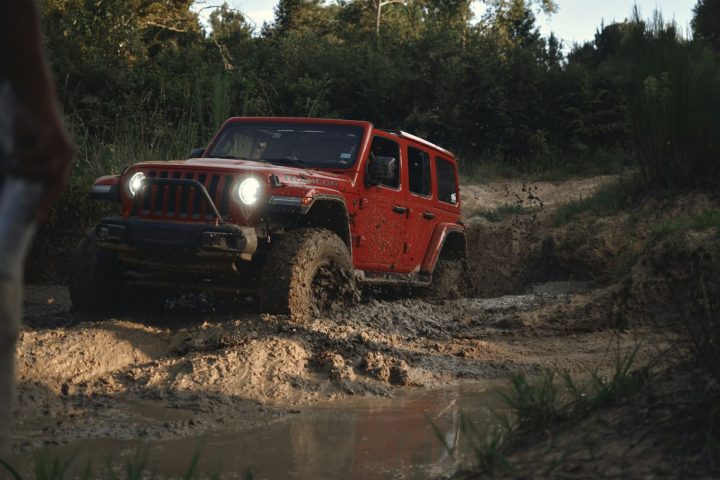
That's exactly what you want in low traction. If the rear tires are on ice and the fronts are on gravel, the fronts keep pulling, because a locked transfer case doesn't hunt for the path of least resistance. It's also why part-time 4WD is strictly a tool for slick or loose surfaces. Drive it on dry asphalt and the steering tightens up in parking-lot turns, the tires scrub and chirp, and eventually you get crow-hop, where the truck lurches and skips as tires break loose to relieve the bind. Keep at it and you're loading U-joints, CV joints, the transfer case chain and the front differential far beyond what they were designed to take.
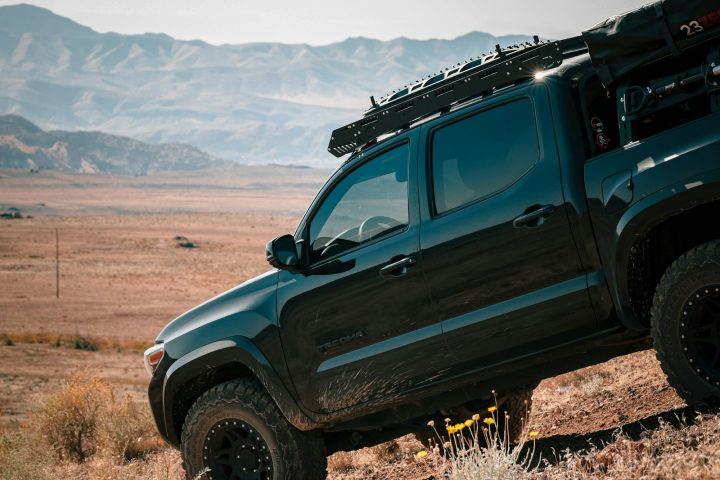
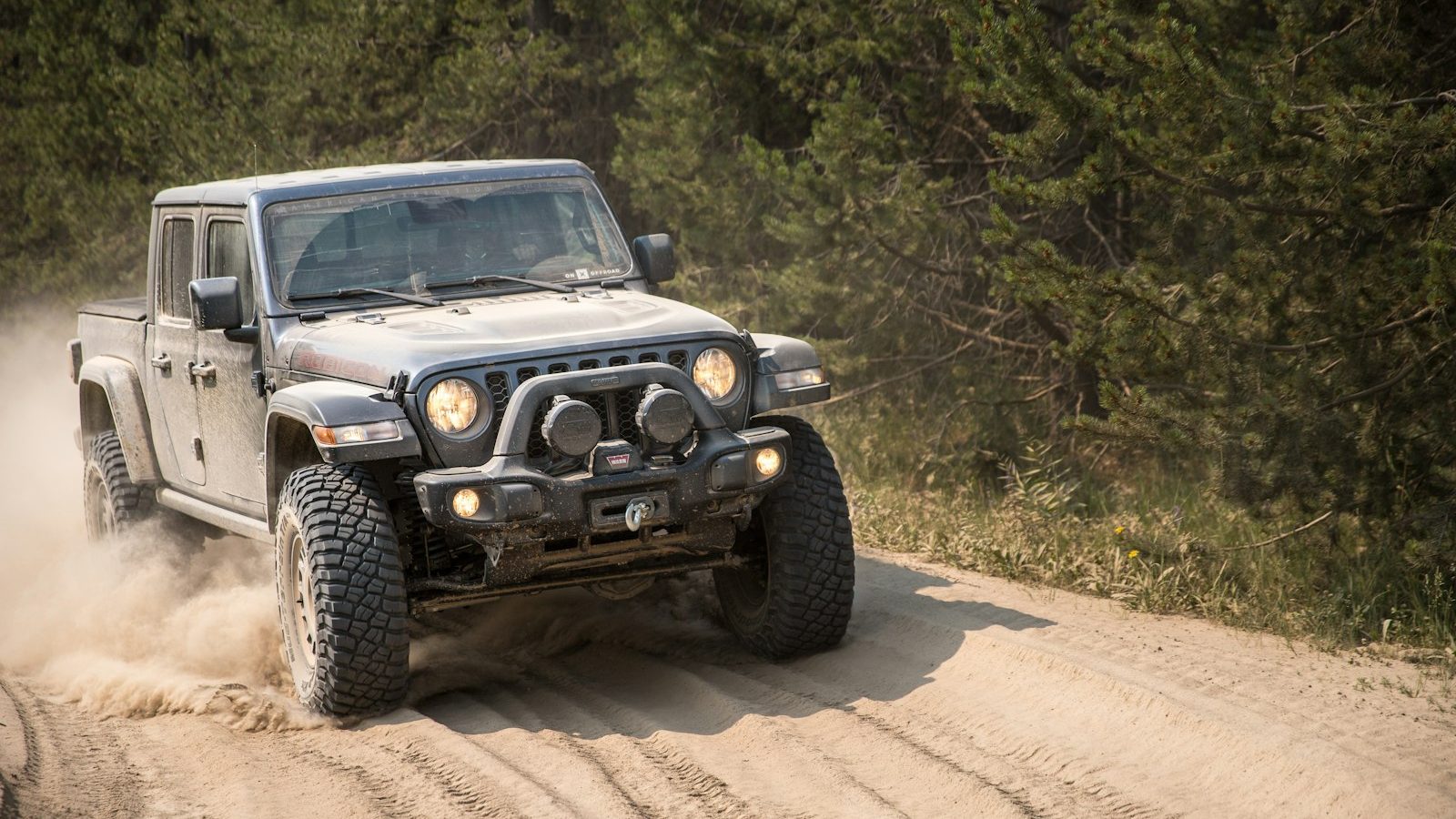
Plenty of 2026 trucks still use part-time 4WD. Toyota lists 4WDemand part-time 4WD on most Tacoma 4x4 trims. Nissan's Frontier uses a part-time case with 2WD, 4H and 4LO positions. The F-150 XL, STX and XLT get an electronic shift-on-the-fly part-time case, and the Jeep Gladiator's Command-Trac and Rock-Trac cases are part-time as well.
The dry pavement rule
Nissan's 2026 Frontier owner's manual says not to drive in 4H or 4LO on dry, hard-surfaced roads because of noise, tire wear and fuel use. The same rule applies to every part-time system. When the road dries out, go back to 2H.
Where the power goes in each mode
2H: rear-wheel drive
The transfer case sends everything to the rear driveshaft. The front axle freewheels because the hubs or axle-disconnect are unlocked.
- Use it for
- Dry pavement, highway, daily driving
- Why
- Least driveline wear, best fuel economy
4H: front and rear locked together
On a part-time system both driveshafts turn at exactly the same speed. There is no center differential, so the front and rear cannot slip against each other in a turn.
- Use it for
- Snow, gravel, wet grass, faster sand and mud
- Avoid
- Dry pavement — the driveline binds in tight turns
4L: same lock, plus gear reduction
Power passes through a reduction gearset in the transfer case, typically 2.5:1 to 4:1. Wheel speed drops and torque and engine braking are multiplied by the same factor.
- Use it for
- Steep climbs and descents, rocks, boat ramps, slow deep terrain
- Speed
- Keep it slow; many manuals cap 4L around 25–30 mph
AWD / Auto 4WD: front and rear can differ
A center differential or computer-controlled clutch pack lets the axles turn at different speeds, so it is safe on any surface. Auto modes add front torque when the rear starts to slip.
- Use it for
- Changing conditions, wet or icy roads, towing on slick highways
- Note
- Crossover-style AWD has no low range
Full-time 4WD and the lockable center differential
Full-time 4WD adds a center differential inside the transfer case. It does between the axles what an axle differential does between the wheels: it lets the front and rear driveshafts turn at different speeds while still sending torque to both. The truck can stay in 4WD on any surface, including a dry highway, without binding.
The catch is the same one an open axle differential has. A plain center differential sends torque wherever it's easiest to go, so if one axle loses grip, the other doesn't get much help. That's why capable full-time systems let you lock the center differential. Locked, it behaves like part-time 4WD, with the same great traction and the same no-dry-pavement rule. Some designs add a viscous coupling or clutch pack to bias torque toward the axle with grip before you ever press a button.
Toyota's 2026 Tacoma Limited with the i-FORCE MAX hybrid is a current example. Toyota lists full-time 4WD with an electronic locking center differential on that trim, while the rest of the Tacoma 4x4 lineup stays part-time. Jeep has also offered a full-time transfer case on upper Gladiator trims since the 2024 update.
Automatic 4WD: Ford's 4A, GM's Auto 4WD and clutch-pack transfer cases
Automatic, or on-demand, 4WD splits the difference between part-time and full-time. Instead of a center differential, the transfer case uses a wet multi-plate clutch pack between the rear output and the front drive. In the automatic position (Ford labels it 4A, and GM trucks with an Autotrac two-speed case call it Auto 4WD), a control module watches wheel speed, throttle and other inputs and clamps that clutch as needed, from a light preload up to nearly locked. Because the clutch can slip, the system doesn't bind in normal driving, so you can leave it in the auto mode on a road that alternates between dry, wet and icy.
Select 4H or 4L and the case ties the front and rear together, either by clamping the clutch fully or with a mechanical lock, depending on the design. At that point it follows part-time rules. Ford's 2026 F-150 spec sheet shows how one model can carry three different layouts:
- XL, STX and XLT: electronic shift-on-the-fly part-time transfer case.
- Lariat, King Ranch and Platinum: Torque On Demand two-speed automatic four-wheel drive.
- Lobo, Tremor and Raptor: two-speed automatic AWD with mechanical-locking 4WD.
The Ranger follows the same pattern. Ford lists an electronic shift-on-the-fly part-time case for the XL, XLT and Lariat, and Advanced 4x4 with automatic on-demand engagement for the Raptor. On the GM side, Chevrolet lists an Autotrac two-speed transfer case on Silverado Trail Boss models.
Auto mode has limits
A slipping clutch makes heat. Long pulls through deep sand or mud in the auto position ask the clutch pack to modulate constantly. When the going is loose and sustained, select 4H or 4L so the front drive is fully engaged, and go back to auto when you're on mixed roads again.
Crossover-style AWD pickups: Ridgeline, Maverick and Santa Cruz
Unibody pickups built on crossover-style platforms use all-wheel drive with no two-speed transfer case and, most importantly, no low range. The engine sits sideways up front, the front wheels do most of the work on dry roads, and a coupling sends torque to a rear drive unit when the system sees or expects slip.
- Honda Ridgeline: Honda's 2026 lineup uses the i-VTM4 AWD system paired with Intelligent Traction Management, which adds Snow, Sand and Mud modes to the Normal setting.
- Ford Maverick: the hybrid comes with front-wheel drive, and all-wheel drive is available. The Tremor adds what Ford calls Advanced 4WD with a twin-clutch rear drive unit and a rear drive unit lock.
- Hyundai Santa Cruz: front-wheel drive is standard on the SE, SEL and SEL Activity, with HTRAC AWD available. The XRT and Limited get HTRAC AWD standard.
These trucks are very good on wet roads, snow, gravel and graded dirt. What they lack is gear reduction. Without low range, a steep, slow, technical climb has to be managed with first gear, the torque converter and the brakes, and the rear coupling takes a lot of heat in the process. For towing a boat up a slick ramp or crawling a rocky trail, a two-speed transfer case is the better tool.
Inside the transfer case: chain drive, gear drive and low range
The transfer case is the gearbox bolted behind the transmission that splits power between the axles. Two design details matter to owners.
Chain-driven vs gear-driven
Nearly every modern pickup uses a chain-driven transfer case. A wide chain links the rear output shaft to the front output, which keeps the case compact, light and quiet. The trade-off is wear. Chains stretch over time, especially with bigger tires and hard launches, and a stretched chain can slap the case or jump a tooth. Fresh fluid at the interval in your manual is cheap insurance, and our transfer case and differential maintenance guide covers what to check.
Gear-driven cases use a train of gears instead of a chain. They're heavier and noisier, and they're nearly indestructible. The old New Process 205 is the classic factory example, and aftermarket gear-driven units such as the Advance Adapters Atlas are still the go-to for heavy rock-crawling builds.
Two-speed cases and low range
Most true 4x4 transfer cases are two-speed. High range passes power straight through at 1:1. Low range routes it through a reduction gearset that slows the output and multiplies torque, typically somewhere around 2.5:1 to 4:1. Jeep's specs show the spread: the Gladiator's Command-Trac case has used a 2.72:1 low range, while the Rubicon's Rock-Trac case uses 4:1. The 4-High vs 4-Low guide covers when to use each range and how to shift between them.
Front axle engagement: manual hubs, auto hubs, IWE and axle disconnect
Engaging the transfer case is only half the job. On many trucks the front axle is partly disconnected in 2WD so the front differential, axle shafts and driveshaft aren't spinning for nothing, which saves a little fuel and wear. Something has to reconnect it when you select 4WD.
- Manual locking hubs. Dials in the center of each front wheel that you turn to LOCK by hand. Simple and reliable. Forget to lock them and you'll have a 4WD light on the dash and a truck that still only drives the rear wheels.
- Automatic locking hubs. These lock themselves when the front axle starts to drive and typically release when you back up a few feet in 2WD. Convenient, though worn or cold hubs can be slow to engage.
- Integrated wheel ends (IWE). Common on independent-front-suspension trucks and usually vacuum-operated: vacuum holds the hub disengaged, and releasing it lets the hub engage. A cracked vacuum line or failed solenoid often shows up as a grinding noise from the front wheels in 2WD.
- Axle disconnect. Instead of working at the hubs, an actuator at the front differential couples or uncouples one axle shaft. When that actuator fails, you'll see 4WD indicators with no front drive.
Full-time and automatic systems keep the front driveline connected or reconnect it on the fly, so there's nothing to lock by hand.
Where traction control, terrain modes and lockers fit
This is the part that trips up a lot of new owners: 4WD doesn't mean four tires are pulling. Each axle still has a differential, and an open differential sends equal torque to both sides. When one tire is in the air, the other one gets the same near-zero torque. A 4x4 with open differentials can be stopped cold by two diagonally opposite tires losing grip.
Brake-based traction control is the modern fix. The ABS module applies the brake on the spinning wheel, which pushes torque across the differential to the tire that has grip. Terrain modes, such as Toyota's Multi-Terrain Select, Honda's Intelligent Traction Management and Hyundai's Terrain Mode Select, retune throttle response, shift points and how the traction control behaves for mud, sand, snow or rock. Toyota says Multi-Terrain Select works in both 4WD-High and 4WD-Low on the Tacoma.
Mechanical locking differentials go a step further and tie both wheels on an axle together. They're the hardware answer to the same problem, and locking differentials explained covers every type in detail. On most AWD pickups, brake-based traction control does the heavy lifting. On a 4x4 with low range, it's the backup to a locker.
4WD vs AWD compared
| System | What links front and rear | Low range | Dry pavement | 2026 examples |
|---|---|---|---|---|
| Part-time 4WD | Nothing in 2H; locked together in 4H and 4L | Yes | 2H only | Most Tacoma 4x4 trims, Frontier, F-150 XL/STX/XLT, Gladiator |
| Full-time 4WD | Center differential, usually lockable | Usually | Yes, with the center diff unlocked | Tacoma Limited i-FORCE MAX |
| Automatic / on-demand 4WD | Clutch pack in the transfer case | Yes | Yes, in the auto mode | F-150 Lariat and up, Ranger Raptor, Silverado with Autotrac |
| Crossover-style AWD | Coupling or clutches at the rear drive unit | No | Yes | Ridgeline, Maverick AWD, Santa Cruz HTRAC |
Which one you need: matching the system to your driving
Match the drivetrain to the worst 10 percent of your driving, not the easiest 90 percent.
- Mostly pavement, with rain, snow and the occasional gravel road: AWD or a truck with an automatic 4WD mode is the easiest to live with. There's no guessing when to shift and no binding when the road dries in patches.
- Northern winters with long stretches of mixed road: automatic or full-time 4WD. Staying in 4WD on a road that's dry for a mile and glazed the next is exactly what these systems exist for.
- Towing a boat or camper to lakes and dirt campgrounds: get low range. A two-speed case lets you walk a heavy trailer up a slick ramp without slipping the torque converter and cooking the transmission. Check the numbers in our towing capacity guide too.
- Trails, mud, sand and rocks: part-time or automatic 4WD with low range, ideally with at least a rear locker. The mechanical simplicity of part-time 4WD is an asset a long way from a parts counter.
Pros of a traditional 4x4 with low range
- Gear reduction for crawling, steep grades and slippery ramps
- Front and rear can be locked together for maximum traction
- Usually paired with body-on-frame construction and stronger axles
- Wide aftermarket support for lockers, gearing and armor
Cons
- Part-time systems demand that the driver choose the right mode
- More fluids and parts to service, including the transfer case and front differential
- Binding and possible damage if 4H or 4L is left on dry pavement
- Heavier, and usually thirstier, than a unibody AWD pickup
If you're still deciding on truck size as well as drivetrain, read midsize vs full-size 4x4 trucks next, then use the Truck Finder to filter the 2026 lineup by drivetrain, low range and factory lockers.
The short version: AWD handles weather, automatic 4WD handles weather and mixed surfaces, and a two-speed part-time or automatic case handles all of that plus the slow, steep, heavy work that makes a 4x4 a 4x4. Know which one you have, know which button does what, and keep part-time 4WD off dry pavement.
Frequently asked questions
Can I drive in 4WD on the highway?
It depends on the system. Full-time 4WD and automatic modes like Ford's 4A or GM's Auto 4WD are designed for any surface, including dry highway. Part-time 4H is fine on a snow-covered or icy highway at a sensible speed, but it binds on dry pavement. Nissan's 2026 Frontier manual, for example, says speeds over 62 mph in 4H are not recommended. Check your owner's manual for your truck's limit.
Is AWD or 4WD better in snow?
For plowed and partly plowed roads, AWD and automatic 4WD are the most convenient because they react on their own and don't bind on dry patches. In deep, unplowed snow or on steep snowy grades, a 4x4 with low range and good ground clearance has the advantage. In every case, winter tires do more for grip and braking than the drivetrain does.
What does 4A mean on a Ford truck?
4A is Ford's automatic four-wheel-drive mode. The transfer case uses an electronically controlled clutch pack to send torque to the front axle as conditions require, so the truck can stay in 4A on mixed surfaces without the binding a locked part-time system would create. On the 2026 F-150 it comes with Torque On Demand cases on Lariat and above, and with the automatic AWD case on Lobo, Tremor and Raptor.
Why does my truck hop or bind in 4WD on pavement?
That's driveline wind-up. In part-time 4H or 4L the front and rear driveshafts are locked together, but in a turn the front tires travel farther than the rears. On dry pavement the tires can't slip to make up the difference, so the driveline twists until a tire breaks loose and the truck hops. Shift back to 2H on dry roads to avoid damaging U-joints, CV joints and the transfer case.
Do AWD pickups like the Ridgeline and Maverick have low range?
No. Crossover-style AWD pickups such as the Honda Ridgeline, Ford Maverick and Hyundai Santa Cruz don't have a two-speed transfer case, so there's no low range. They handle snow, rain, gravel and graded dirt well, but steep technical climbs and slow crawling rely on first gear and the brakes. For heavy ramp work or rock trails, a truck with a two-speed transfer case is the better choice.
Sources & further reading 11
- fromtheroad.ford.comfromtheroad.ford.com/content/dam/fordmediasite/us/en/library/2026/specs/2026_Ford_F150_Specs.pdf
- fromtheroad.ford.comfromtheroad.ford.com/content/dam/fordmediasite/us/en/library/2026/specs/2026_Ford_Ranger%20Technical_Specs.pdf
- toyota.comtoyota.com/tacoma/
- pressroom.toyota.compressroom.toyota.com/the-2026-toyota-tacoma-adventure-awaits/
- nissanusa.comnissanusa.com/content/dam/Nissan/us/manuals-and-guides/frontier/2026/2026-nissan-frontier-owner-manual.pdf
- jeep.comjeep.com/gladiator/capability.html
- media.stellantisnorthamerica.commedia.stellantisnorthamerica.com/newsrelease.do?id=25289
- chevrolet.comchevrolet.com/trucks/silverado/1500
- automobiles.honda.comautomobiles.honda.com/ridgeline
- ford.comford.com/trucks/maverick/
- hyundaiusa.comhyundaiusa.com/us/en/vehicles/santa-cruz/compare-specs
Specs and ratings change between model years and configurations. Confirm numbers for your exact truck in the owner's manual and on the door-jamb labels.