85 terms
The 4x4 glossary
Every 4x4, off-road and towing term, defined in plain English. Every term links to the guide that goes deeper.
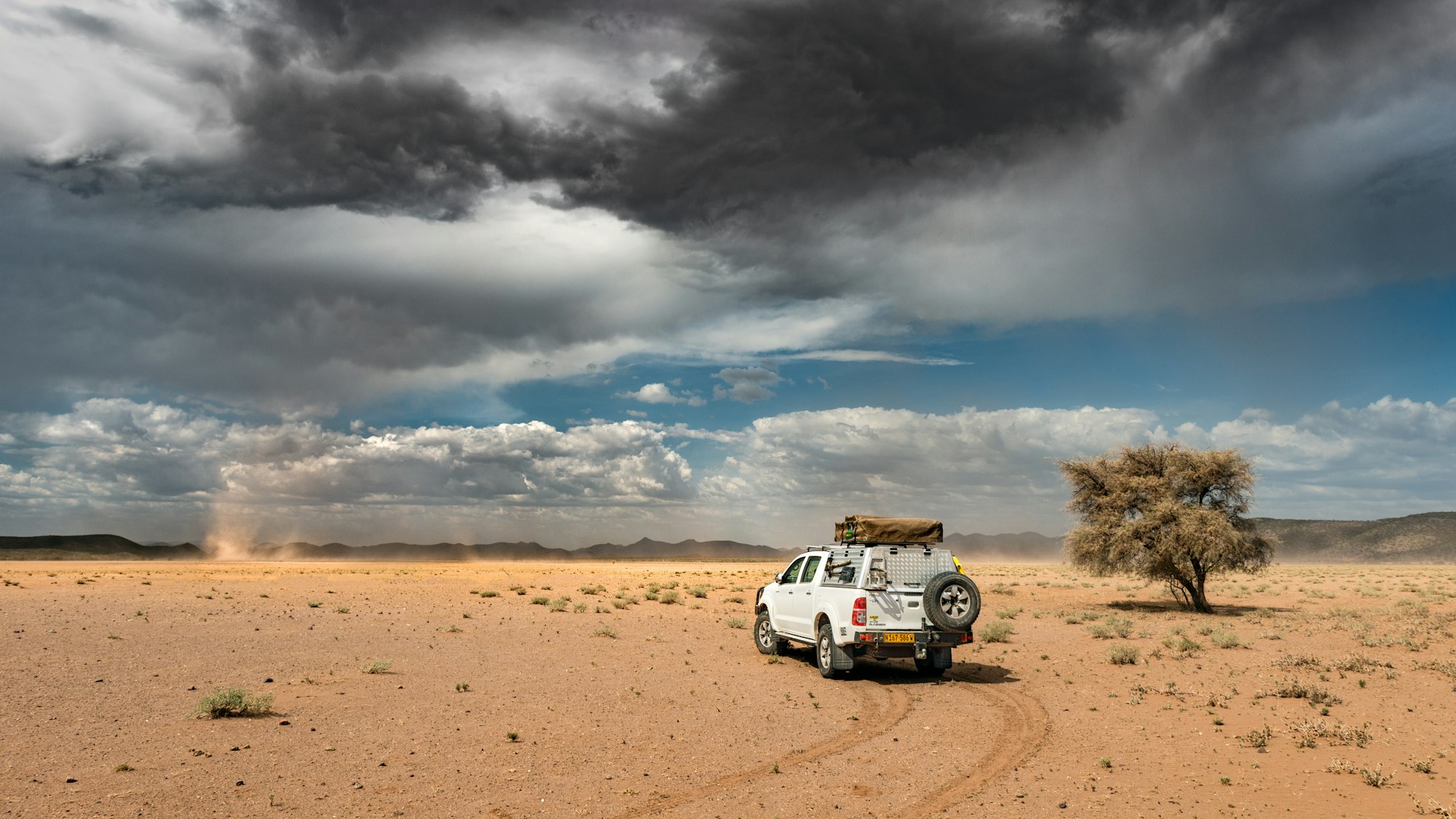
Photo: Andrew Svk / Unsplash
- 2Halso: 2WD, two-high#
-
Two-wheel-drive high range. On most 4x4 pickups the transfer case sends all power to the rear axle and the front axle freewheels. It is the mode for dry pavement and everyday driving, because it causes the least driveline wear and uses the least fuel.
4WD vs AWD, explained - 4-Highalso: 4H, 4HI#
-
Four-wheel drive with the transfer case in its 1:1 high range. On a part-time system the front and rear driveshafts are locked together, which helps on snow, gravel, wet grass and faster sand, but causes binding in turns on dry pavement.
4-High vs 4-Low - 4-Lowalso: 4L, 4LO, low range#
-
Four-wheel drive with the transfer case in its reduction gear, usually somewhere around 2.5:1 to 4:1. Wheel speed drops and torque and engine braking rise by the same factor. It is for steep climbs and descents, rock crawling, boat ramps and slow, heavy pulls.
4-High vs 4-Low
- Air locker#
-
A selectable locking differential engaged by air pressure from an onboard compressor, typically through a dash switch. ARB's Air Locker is the best-known example. It behaves like an open differential until you lock it, then ties both axle shafts together.
Lockers explained - Airing downalso: aired down#
-
Lowering tire pressure for off-road driving. A softer tire lengthens its footprint, flexes around rocks, rides better on washboard and floats in sand. You must air back up before driving at highway speeds, and there is a real risk of unseating a bead if you go too low.
Airing down, done right - All-terrain tirealso: A/T, AT tire#
-
A tire with a tread pattern that balances on-road manners with off-road grip: moderately sized tread blocks, lots of siping and moderate void. Many carry the three-peak mountain snowflake for severe snow service. It is the default choice for most 4x4 trucks.
A/T vs M/T tires - All-wheel drivealso: AWD#
-
A drive system that powers all four wheels through a center differential or clutch pack so the front and rear can turn at different speeds. Crossover-style AWD, as on the Ridgeline, Maverick and Santa Cruz, has no low range and is meant for traction on slick roads and light trails.
4WD vs AWD, explained - Approach angle#
-
The steepest ramp a vehicle can drive onto without the front bumper or chassis touching it, measured from the ground through the front tire's contact point to the lowest part of the front overhang. Bigger tires, lift and high-clearance bumpers improve it.
The three angles, explained - Articulationalso: flex, wheel travel#
-
How far a suspension lets the wheels move up and down relative to each other, keeping all four tires on the ground over uneven terrain. More articulation means more traction on rocks and cross-axle ruts. Sway-bar disconnects and long-travel suspension increase it.
Off-road driving basics - Aspect ratio#
-
The number after the slash in a metric tire size. It is the sidewall height as a percentage of the tread width, so a 285/70R17 has a sidewall 70% as tall as its 285 mm width. Taller sidewalls flex more when aired down.
How to read a tire size - Auto 4WDalso: 4A, automatic 4WD, on-demand 4WD#
-
A four-wheel-drive mode, labeled 4A or Auto on many trucks, that uses a clutch pack in the transfer case to send power to the front axle only when the rear starts to slip. Unlike part-time 4H, it is safe to leave engaged on mixed wet and dry pavement.
4WD vs AWD, explained - Axle ratioalso: gear ratio, ring and pinion, final drive#
-
How many times the driveshaft turns for each turn of the wheels, set by the ring and pinion gears in each differential. A 4.10 ratio is lower (numerically higher) than a 3.73 and gives more acceleration and pulling power at the cost of higher highway rpm.
Regearing guide - Axle wrap#
-
Twisting of a leaf-spring rear axle under hard acceleration or braking, where the springs wind up in an S shape and then let go, causing wheel hop. Traction bars and stiffer or longer spring packs reduce it.
Lift kits explained
- Backspacingalso: offset#
-
The distance from a wheel's mounting surface to its inner edge. Less backspacing pushes the wheel and tire outward, widening the stance and clearing suspension parts, but it increases scrub radius and load on wheel bearings.
How to read a tire size - Beadlockalso: bead lock, beadlock wheel#
-
A wheel design that mechanically clamps the tire's outer bead to the rim with a bolted ring, so the tire cannot unseat at very low pressures. True beadlocks are common for rock crawling; many are not rated for highway use, so check the maker's rating.
Airing down, done right - Body lift#
-
Spacers installed between a truck's body and frame to raise the body, usually 1 to 3 inches, making room for larger tires. It does not change suspension geometry or ground clearance under the axles; only the bigger tires do that.
Leveling vs lift vs body lift - Body-on-framealso: ladder frame#
-
A construction method where the body is bolted to a separate ladder frame. Most pickups are built this way, which suits heavy towing, payload and off-road abuse. The alternative is unibody construction.
Midsize vs full-size - Breakover anglealso: ramp breakover#
-
The sharpest crest a vehicle can drive over without the underside touching it, formed by lines tangent to the front and rear tires meeting at the lowest point between the axles. Long wheelbases lose breakover; a quick estimate is 2 × atan(2 × clearance ÷ wheelbase).
The three angles, explained - Bump stop#
-
A rubber, polyurethane or hydraulic stop that limits how far the suspension can compress, protecting the frame, shocks and tires on hard hits. Hydraulic bump stops on desert-running trucks absorb big landings progressively.
Lift kits explained - Bypass shock#
-
A shock absorber with external tubes that let oil bypass the piston in certain zones of travel, so it can be soft in the middle of its stroke and firm near the ends. Common on high-speed off-road suspensions.
Lift kits explained
- Center differential#
-
A differential between the front and rear driveshafts that lets them turn at different speeds, as they must in turns. It is what makes full-time 4WD and AWD safe on pavement. Many can be locked for off-road use.
4WD vs AWD, explained - Coilover#
-
A shock absorber with a coil spring mounted around it as a single unit. Aftermarket coilovers often allow ride-height adjustment and are the heart of many independent front suspension lift kits.
Lift kits explained - Crawl controlalso: Trail Control#
-
A low-speed off-road cruise control that manages throttle and brakes so the vehicle holds a set crawling speed over rocks and steep grades while the driver steers. Toyota's CRAWL Control and Ford's Trail Control are examples.
4-High vs 4-Low - Crawl ratio#
-
The total gear reduction in a truck's lowest gear: first gear × low range × axle ratio. A higher number means slower, more controlled crawling and more torque multiplication. For example, 4.71 × 2.72 × 3.73 ≈ 47.8:1.
4-High vs 4-Low - Curb weight#
-
The weight of a vehicle with standard equipment and full fluids, but no passengers or cargo. Subtract it from GVWR to get payload capacity for your exact truck.
Towing capacity, decoded - CV axlealso: constant velocity joint, half-shaft#
-
A front drive axle with constant-velocity joints at each end, used on independent front suspension. CV joints deliver smooth power at changing angles, but lifting an IFS truck steepens those angles and can shorten their life. Torn boots let grease out and dirt in.
Maintenance schedule
- Departure angle#
-
The steepest ramp a vehicle can drive off without the rear bumper, hitch or exhaust touching, measured from the rear tire to the lowest point of the rear overhang. Receiver hitches and long overhangs reduce it.
The three angles, explained - Differentialalso: diff#
-
A gearset that splits power between two wheels on an axle while letting them turn at different speeds in a corner. An open differential sends equal torque to both sides, which is why one spinning wheel can leave you stuck.
Lockers explained - Driveline bindalso: crow-hop, wind-up#
-
Stress that builds in a part-time 4WD driveline when the front and rear axles are locked together but need to turn at different speeds, as in a turn on dry pavement. It causes hopping, tire scrub and parts damage.
4WD vs AWD, explained - Drop bracket#
-
A bracket that relocates suspension mounting points downward on the frame, a common way lift kits restore geometry. Drop-bracket IFS lifts lower the whole front suspension and differential relative to the frame.
Lift kits explained
- Fifth-wheel hitchalso: 5th wheel#
-
A heavy-duty coupling mounted in the truck bed over or slightly ahead of the rear axle, used for large travel trailers. Pin weight is typically about 15 to 25% of the trailer weight, far more than a bumper-pull trailer.
Towing capacity, decoded - Flotation tire size#
-
A tire size written as overall diameter × width × rim, such as 35x12.50R17. The first number is the nominal height in inches, which is why people call them 35s. Metric sizes need a quick calculation to get the same number.
How to read a tire size - Full-time 4WD#
-
A four-wheel-drive system with a center differential, so all four wheels are driven all the time and the truck can be driven on dry pavement. Many full-time systems let you lock the center differential and also have a low range.
4WD vs AWD, explained
- GAWRalso: gross axle weight rating#
-
Gross Axle Weight Rating: the most weight each axle may carry. It is printed on the door-jamb certification label. A heavy tongue can overload the rear axle even when the truck is under its total GVWR.
Towing capacity, decoded - GCWRalso: gross combined weight rating#
-
Gross Combined Weight Rating: the most a loaded truck and loaded trailer may weigh together. Heavy passengers and cargo in the truck reduce how much trailer you can pull without exceeding it.
Towing capacity, decoded - Gooseneck hitch#
-
A ball hitch mounted in the truck bed above the rear axle, used for livestock, flatbed and some RV trailers. Like a fifth wheel, it puts a large share of trailer weight on the truck, typically in the 15 to 25% range.
Towing capacity, decoded - Ground clearance#
-
The distance from the ground to the lowest point of the vehicle, often the rear differential on solid-axle trucks. Manufacturers usually quote the best-case figure for a specific trim, so check which point they measured.
The three angles, explained - GVWRalso: gross vehicle weight rating#
-
Gross Vehicle Weight Rating: the most the truck may weigh fully loaded, including people, cargo, accessories and trailer tongue weight. Find it on the certification label in the driver's door jamb.
Towing capacity, decoded
- High-lift jack#
-
A tall mechanical farm-style jack that can lift a vehicle by its bumper or rock sliders high enough to stack rocks under a tire or reset a bead. It is useful but notoriously dangerous: the handle can whip, and the load can slip.
The recovery kit
- IFSalso: independent front suspension#
-
Independent front suspension, where each front wheel moves on its own control arms instead of sharing a solid axle. Most modern pickups use it for ride and handling. It usually has less articulation than a solid axle.
Lift kits explained - Integrated wheel endsalso: IWE, automatic hubs#
-
A front-axle disconnect system that locks and unlocks the front hubs with vacuum or electric actuators when you select 4WD, so the front axle shafts do not spin in 2WD. It replaces manual locking hubs on many trucks.
4WD vs AWD, explained
- Kinetic recovery ropealso: kinetic rope, snatch rope#
-
A nylon rope that stretches, often around 20 to 30%, and stores energy during a recovery, giving a smoother, stronger pull than a static strap. It must attach only to rated recovery points and never to a tow ball.
The recovery kit
- Leaf spring#
-
A suspension spring made of stacked, curved steel leaves, used on the rear of most pickups. It locates the axle and carries load. Lifts use longer shackles, blocks, add-a-leafs or new spring packs.
Lift kits explained - Leveling kit#
-
Parts that raise the front of a truck, usually 1.5 to 2.5 inches, to remove the factory rake so it sits level. Strut spacers and torsion-key adjustments are common. It makes room for slightly larger tires.
Leveling vs lift vs body lift - Limited-slip differentialalso: LSD, limited slip#
-
A differential that resists speed differences between its two wheels using clutches or gears, sending more torque to the wheel with grip. It helps in snow and mud and stays drivable on pavement, but it is not as decisive as a locker.
Lockers explained - Load index#
-
A number on the tire that stands for its maximum load at a specified pressure. LT tires often show two, such as 121/118: the first for single-rear-wheel use and the second for dual rear wheels.
How to read a tire size - Load rangealso: ply rating#
-
A letter showing an LT tire's strength and maximum pressure, replacing the old ply rating. Load range C, D, E and F tires have progressively higher load capacity; E is the common choice for heavy-duty trucks and serious towing.
How to read a tire size - Locking differentialalso: locker, diff lock#
-
A differential that can tie both wheels on an axle together so they turn at the same speed regardless of traction. It is the single most effective traction upgrade off-road. Engage it before the obstacle, with the wheels straight, and not on pavement.
Lockers explained - Lunchbox locker#
-
An automatic locker that replaces the side gears inside an existing open differential carrier. It locks under power and ratchets in turns. Cheap and simple, but it can clunk and make the truck push in corners.
Lockers explained
- Manual locking hubsalso: manual hubs, lockouts#
-
Dials on the front wheel hubs that connect or disconnect the front axle shafts. With them unlocked in 2WD, the front axle does not spin, reducing wear. You must get out and lock them before using 4WD.
4WD vs AWD, explained - Mud-terrain tirealso: M/T, MT tire#
-
An aggressive tire with large tread blocks and wide voids that clean out mud, plus tough sidewalls. It grips well in mud and rocks but is louder, wears faster and is usually weaker on ice than an all-terrain.
A/T vs M/T tires
- Open differential#
-
The standard differential that splits torque equally between two wheels. When one wheel has almost no grip, the other gets almost no torque too, which is why a truck can sit with one tire spinning.
Lockers explained - Overlanding#
-
Self-reliant, multi-day vehicle travel where the journey is the point, usually with camping gear, water and recovery equipment carried on board. Payload management is the most overlooked part of an overland build.
Overlanding build plan
- Part-time 4WD#
-
A 4WD system with no center differential. In 4H or 4L the front and rear driveshafts are locked together, which is great for traction but causes driveline bind on high-grip surfaces, so it is only for loose or slippery ground.
4WD vs AWD, explained - Payload#
-
How much weight you can add to a truck: passengers, cargo, accessories and trailer tongue weight all count. Your exact truck's figure is on the yellow Tire and Loading Information placard in the door jamb.
Towing capacity, decoded - Pinion angle#
-
The angle of the differential's input shaft relative to the driveshaft. Lifting a truck changes it, and if the angles do not match, U-joints vibrate and wear. Shims or adjustable control arms correct it.
Lift kits explained
- Range-extended EValso: EREV, range extender#
-
An electric vehicle that drives only on its electric motors but carries a gas engine that works as a generator to recharge the battery on longer trips. Several truckmakers have announced range-extended pickups.
Gas vs diesel vs hybrid vs EV - Recovery pointalso: rated recovery point#
-
A frame-mounted hook, shackle mount or receiver-based shackle block rated for recovery loads. Tow balls and tie-down loops are not recovery points and can fail violently.
The recovery kit - Regearingalso: regear#
-
Replacing the ring and pinion gears in both differentials with a numerically higher ratio, usually after installing larger tires, to restore acceleration, towing ability and proper transmission shift points.
Regearing guide - Rock slidersalso: sliders#
-
Heavy steel rails bolted or welded to the frame along the rocker panels, protecting the body when the truck slides off a rock. Step bars mounted to the body are not sliders and can crush the rockers.
Armor guide - Rugged-terrain tirealso: R/T, hybrid-terrain#
-
A hybrid category between all-terrain and mud-terrain: an A/T-style center tread with more aggressive shoulder and sidewall lugs. It trades a little road manners for better mud and rock grip.
A/T vs M/T tires
- Selectable lockeralso: e-locker, electronic locker#
-
A locking differential you turn on and off with a switch, using electric, air or cable actuation. It drives like an open differential on the road and locks only when you need it, which is why most factory lockers are selectable.
Lockers explained - Shift-on-the-fly#
-
A 4WD system that can switch between 2H and 4H while moving, usually below a speed set by the manufacturer. Shifting into or out of 4L still generally requires stopping or rolling slowly in neutral.
4-High vs 4-Low - Skid plate#
-
A plate of steel, aluminum or UHMW plastic that protects the oil pan, transmission, transfer case, fuel tank or differentials from rocks. Factory skids are often thin; aftermarket plates are thicker and cover more.
Armor guide - Slip yoke#
-
The splined joint at the end of a driveshaft that lets it change length as the suspension moves. Lifts can pull it too far out, and dry splines cause clunks and vibration. Some need periodic grease.
Maintenance schedule - Snatch block#
-
A pulley that lets a winch line change direction or double back to the vehicle. A double-line pull roughly doubles pulling force and halves line speed, and it reduces the load on the winch.
The recovery kit - Soft shackle#
-
A loop of synthetic rope with a knotted closure, used to connect recovery gear. It is lighter than a steel D-ring and far less dangerous if something fails, but it must be rated for the load and protected from sharp edges.
The recovery kit - Solid axlealso: live axle, straight axle#
-
An axle where both wheels are connected by a single rigid housing. It is strong, simple and articulates well, which is why it is favored for rock crawling. Jeep and heavy-duty trucks use solid front axles.
Lift kits explained - Speed rating#
-
A letter on the tire indicating the maximum sustained speed it is rated for at its rated load and pressure. Common truck ratings include Q (99 mph), R (106 mph), S (112 mph) and T (118 mph).
How to read a tire size - Spool#
-
A solid piece that permanently locks both axle shafts together. It is strong and simple but makes a street vehicle hard to turn, so it is mostly for dedicated off-road and competition rigs.
Lockers explained - Sway baralso: stabilizer bar, anti-roll bar#
-
A torsion bar that links the left and right suspension to reduce body roll on the road. It also limits articulation off-road, so some trucks, like the Gladiator Rubicon and Power Wagon, can disconnect the front bar electronically.
Off-road driving basics - Sway-bar disconnectalso: stabilizer disconnect#
-
A mechanism that unlocks the front stabilizer bar so the suspension can articulate freely at low speed off-road. It is a factory feature on trucks such as the Gladiator Rubicon, Power Wagon and Tacoma TRD Pro.
Lockers explained
- Three-peak mountain snowflakealso: 3PMSF#
-
A symbol on the sidewall showing the tire met a standardized snow-traction test. Many all-terrain tires carry it; most mud-terrains carry only M+S, which is not a performance test.
A/T vs M/T tires - Tongue weightalso: hitch weight#
-
The downward force a trailer puts on the hitch ball. For a conventional trailer it should be about 10 to 15% of the trailer's loaded weight. Too little causes sway; too much overloads the rear axle.
Towing capacity, decoded - Torsen differentialalso: helical LSD#
-
A gear-type limited-slip differential that uses worm gears to bias torque toward the wheel with more grip. It works smoothly without clutches but can struggle when one wheel has no load at all.
Lockers explained - Traction boardsalso: recovery boards#
-
Stiff plastic ramps with aggressive cleats that you wedge under a spinning tire in sand, mud or snow to give it something to bite. They are one of the safest self-recovery tools you can carry.
The recovery kit - Traction controlalso: brake-lock differential, A-TRAC#
-
An electronic system that brakes a spinning wheel so an open differential sends torque to the wheel with grip. Off-road modes let more wheelspin through. It is sometimes called a brake-lock differential.
Lockers explained - Transfer casealso: t-case#
-
The gearbox behind the transmission that splits power between the front and rear axles on a 4x4. Two-speed transfer cases add a low range. Chain-driven cases are light and quiet; gear-driven cases are stronger.
4WD vs AWD, explained - Tree saver#
-
A wide, non-stretch strap wrapped around a tree as a winch anchor. It spreads the load, protects the bark and keeps the winch line from being wrapped back on itself.
The recovery kit
- U-jointalso: universal joint#
-
A universal joint: a cross-shaped joint with needle bearings that lets a driveshaft transmit power at an angle. Many need regular grease. Worn U-joints clunk on takeoff and vibrate at speed.
Maintenance schedule - Unibody#
-
A construction method where the body and frame are one welded structure, as on most cars and crossovers. The Honda Ridgeline, Ford Maverick and Hyundai Santa Cruz are unibody pickups, which ride better but tow and haul less.
Midsize vs full-size
- Void ratio#
-
The share of a tire's tread area that is open grooves rather than rubber. Higher void, typical of mud-terrains, clears mud better; lower void, typical of highway and all-terrain tires, is quieter and grips pavement better.
A/T vs M/T tires
- Water fording depthalso: wading depth#
-
The deepest water a manufacturer says a vehicle can drive through at a steady walking pace. It depends on air intake height and breathers. Moving water is far more dangerous than the depth alone suggests.
Off-road driving basics - Weight-distribution hitchalso: WDH, weight-distributing hitch#
-
A hitch with spring bars that transfers some tongue weight forward to the truck's front axle and back to the trailer axles, leveling the rig and restoring steering and braking. Many trucks require one above a certain trailer weight.
Towing capacity, decoded - Winch#
-
An electric or hydraulic drum that pulls a steel cable or synthetic line to self-recover or recover another vehicle. Size it at roughly 1.5 times the vehicle's gross weight and always use a damper, rated points and a clear safety zone.
The recovery kit
No terms match. Suggest one.
Missing a term?
The glossary grows with the site. If you ran into a word in a spec sheet, a forum thread or a shop quote that isn't here, send it to us and we'll add a plain-English definition.