A tire upgrade can leave the spare behind. The four tires on the ground may now have a different size, wheel design or hardware from the assembly still carried under the truck. Before a trip, have the spare reviewed as part of the current vehicle configuration, rather than assuming that an original spare remains a usable answer to every puncture.
This is a planning check to complete with the vehicle manufacturer and a qualified tire or wheel professional. It is not a roadside wheel-change procedure. A spare that cannot be confirmed suitable should change the trip or assistance plan before you leave.
Identify the assembly you actually carry
Bring the shop a record of the truck’s year, model, drivetrain and relevant modifications. Include the installed tire make, model, complete size designation and service description, plus the wheel model and part number. Ask the shop to record current tread depths as part of its review. Record the same information for the spare wherever it is available in the purchase or vehicle records. Our guide to reading tire sizes can help you transcribe the sidewall markings.
Photographs can help identify markings, but avoid crawling under a vehicle or disturbing a heavy spare just to complete the form. Ask the shop to inspect inaccessible details during a scheduled visit. Tell them about brake changes, wheel spacers, replacement hubs or other work that may affect fit.
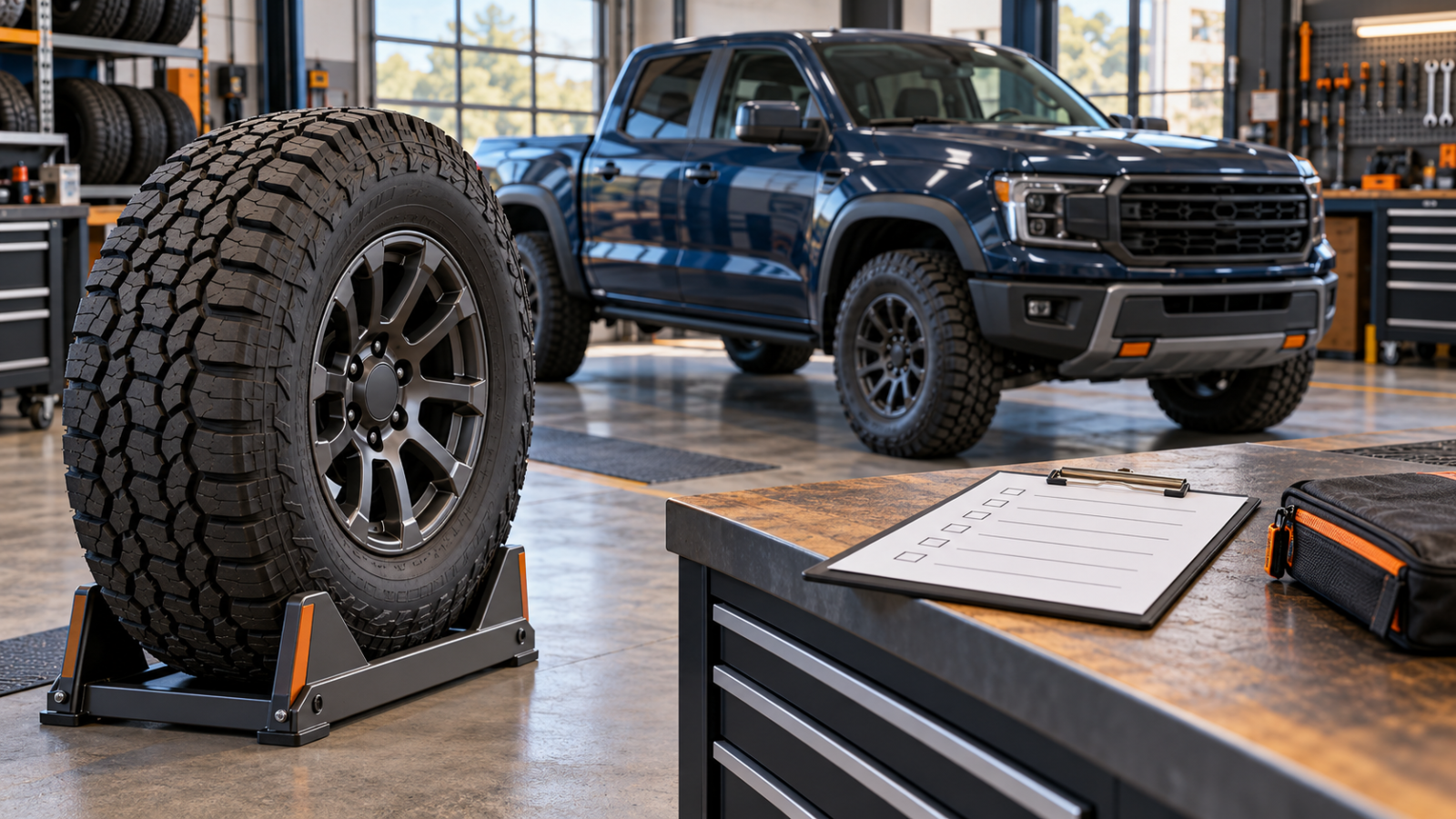
Use a two-column comparison: road assembly and carried spare. Leave unknown fields blank for the technician to resolve. “Full-size” is a description, not proof that the tire, wheel and hardware match the current setup.
Get a vehicle-specific answer about mismatch
The owner’s manual is the starting point for spare-use restrictions. For example, the 2025 Ford F-150 manual explains that spare-tire size can affect four-wheel-drive functionality and gives restrictions for a full-size dissimilar spare. That example illustrates why a spare decision needs the exact manual; its operating limits are not instructions for another truck.
Ask the vehicle manufacturer about spare-use limits, and have a qualified tire or wheel professional check the proposed assembly against the current setup. If the documentation does not cover your modified combination, treat suitability as unresolved rather than assuming permission. Request the applicable restrictions on wheel position, driving modes, speed, distance and towing, where the vehicle’s documentation addresses them. Do not invent a universal acceptable difference in diameter or assume that switching to two-wheel drive resolves every mismatch.
A tire-size calculator can help organize dimensions for a conversation. It cannot approve a combination for the transfer case, differentials or vehicle-control systems. Keep the manufacturer’s answer with the vehicle records, including any unresolved condition.
Check the wheel and its fasteners separately
A tire that appears suitable does not establish that its wheel clears the truck’s brakes or uses the right mounting arrangement. Wheel manufacturer Fastco’s installation checklist treats load rating, physical fit and fastener compatibility as separate checks. Have the professional verify these for every position where the spare may be needed. Ask specifically whether later brake or wheel changes altered the original spare’s suitability.
Fasteners deserve their own entry. McGard’s lug-nut and lug-bolt instructions call for checking the correct fastener style with the wheel manufacturer, including the spare. They also require verification of thread size, length and seat shape. A lug nut that threads onto a stud is not, by itself, evidence that it seats correctly in the spare wheel.
If the spare requires different approved hardware, have the shop identify it clearly and explain its use. Keep the relevant specification with that hardware. Do not improvise with washers, adapters or a socket that only partly engages a fastener.
Include pressure, condition and access
An unused spare still needs attention. Michelin’s routine tire-care guidance includes the spare in monthly pressure checks and recommends checking pressure before a long trip. Start with the vehicle’s spare-specific pressure instructions. If the spare differs from the documented specification, get the applicable cold-pressure recommendation from the tire manufacturer or qualified tire professional. Michelin specifically directs owners changing tire size to seek this advice. A sidewall maximum is not automatically the operating target; follow any spare-specific instructions and markings.
NHTSA warns that spare tires are subject to aging. Ask the tire professional to assess the spare’s condition and age against the applicable manufacturer guidance. Record the inspection date and any replacement recommendation. Do not treat unused tread as proof that a tire is fit for service.
Check that the documented retrieval tools and any wheel-lock key are actually carried and accessible with the truck packed. Have an unfamiliar or obstructed carrier demonstrated safely by the shop. A larger replacement spare also needs a suitable stowage arrangement confirmed for that assembly. The 2025 F-150 Raptor instructions, for example, restrict the original carrier to the supplied tire-and-wheel combination. Do not assume a larger spare is suitable for the original carrier because it fits the space.
Leave with a usable decision
Keep a short record of the accepted tire-and-wheel assembly, required hardware, pressure reference, storage arrangement and vehicle-specific restrictions. Include who checked it, the supporting manual or component instructions, the location of the tools and the assistance contact you would use if a safe wheel change is not possible. Clearly mark unresolved questions; an incomplete record is not a fitment approval.
Revisit that record after tire, wheel, brake or drivetrain changes. The useful outcome is a confirmed plan for the truck as it exists today, with uncertainty resolved before the spare is needed.
Researched planning guidance, not a fitment certification or wheel-changing procedure. Follow the current instructions for your exact vehicle and components. Cover: original AI-generated editorial illustration, not a fitment approval or installation diagram.