All-Terrain vs. Mud-Terrain Tires: How to Pick the Right Tread
Highway, all-terrain, hybrid and mud-terrain tires compared on void ratio, siping, sidewalls, noise, wear, snow ratings, weight and load range, plus who should buy each.
The short version
- More tread void cleans out mud and bites rock, but costs pavement grip, tread life and quiet.
- M+S is based on tread shape alone; only the 3PMSF snowflake means a tire passed a snow traction test.
- The KO3 and Wildpeak A/T4W carry 3PMSF; the Ridge Grappler and KM3 don't.
- A 35x12.50R17 KM3 is listed at 75 lb; heavy, high-resistance tires cost fuel and effective gearing.
- Choose Load Range C for light trucks, E for heavy-duty pickups and towing, then set pressure from load tables.
Buy tires for the miles you actually drive, not the trail you might run someday. An all-terrain covers most trucks most of the time, and a mud-terrain earns its noise, weight and wear only if you regularly need what it does. Between them sits a fast-growing class of hybrid tires, and past them sit rock and competition tires that most people shouldn't drive to work on.
Five Tread Types, From Highway to Extreme
Tire makers use slightly different labels, but truck tires fall into five broad families. The differences come down to how much open space is in the tread, how the blocks are shaped, what the sidewall looks like and what the rubber is designed to do.
All-terrain vs rugged-terrain vs mud-terrain
All-terrain
Tighter blocks, lots of sipes
≈ 25–35% void
- Mud & clay
- Rock & sidewall
- Snow & ice
- Quiet & comfort
- Tread life
Rugged / hybrid-terrain
A/T center, M/T-style shoulders
≈ 30–40% void
- Mud & clay
- Rock & sidewall
- Snow & ice
- Quiet & comfort
- Tread life
Mud-terrain
Huge blocks, wide self-cleaning voids
≈ 40–50% void
- Mud & clay
- Rock & sidewall
- Snow & ice
- Quiet & comfort
- Tread life
| Type | Tread design | Pavement manners | Off-road strength | Snow rating | Best for |
|---|---|---|---|---|---|
| Highway (H/T) | Tight ribs, narrow grooves, lots of sipes | Quietest, longest wearing, best wet braking | Gravel roads only | Usually M+S; a few all-weather designs carry 3PMSF | Daily drivers, pavement towing |
| All-terrain (A/T) | Interlocking blocks, moderate voids, heavy siping | Good; mild hum on some | Dirt, gravel, light rock and mud | Several leading A/Ts carry 3PMSF | Most truck owners |
| Rugged / hybrid terrain (R/T) | A/T-style center, M/T-style shoulders and sidewall lugs | Fair to good; louder than an A/T | Rock and moderate mud | Usually M+S only | Regular trail users who still commute |
| Mud-terrain (M/T) | Large separated lugs, wide voids, few sipes | Loud, shorter tread life, weaker on wet pavement and ice | Mud, clay, rock | Usually M+S only | Frequent mud and hard-core trail use |
| Extreme / rock | Huge lugs, soft sticky compounds | Poor; fast wear | Maximum rock and mud grip | Varies; check the sidewall | Dedicated trail rigs, often trailered |
Extreme and rock-crawling tires get a quick mention here because few pickup owners should buy them. They use very soft rubber and giant lugs that grab rock beautifully and wear quickly on asphalt. Some competition tires aren't built or marked for highway use at all, so read the sidewall before you assume a tire is street legal.
Tread Void Ratio: The Trade-Off Behind Everything
Void ratio is the share of the tread that's open groove instead of rubber. It drives nearly every difference you'll feel between tire types.
More void helps off-road. Big gaps between lugs give mud somewhere to go, and at wheel speed the tire flings that mud out of the channels and exposes fresh edges to bite with. On loose rock and dirt, separated lugs act like paddles and claws. That's the mud-terrain formula: large, separated blocks with wide channels between them.
More void costs you on pavement. Less rubber touches the road, so dry and wet grip drop. Each block has less support from its neighbors, so it squirms, which hurts steering precision and speeds wear. Air gets trapped and released in those big gaps, which is where the classic mud-tire howl comes from.
Highway tires sit at the other extreme, with tightly packed ribs and narrow circumferential grooves that pump water out of the contact patch. All-terrains split the difference with interlocking blocks: enough void to clean out on a dirt road, enough rubber to behave on the interstate. Hybrid tires push the voids wider at the shoulders while keeping a denser center, which is why they drive closer to an A/T than their looks suggest.
Siping, Stone Ejectors and Sidewall Lugs
Siping
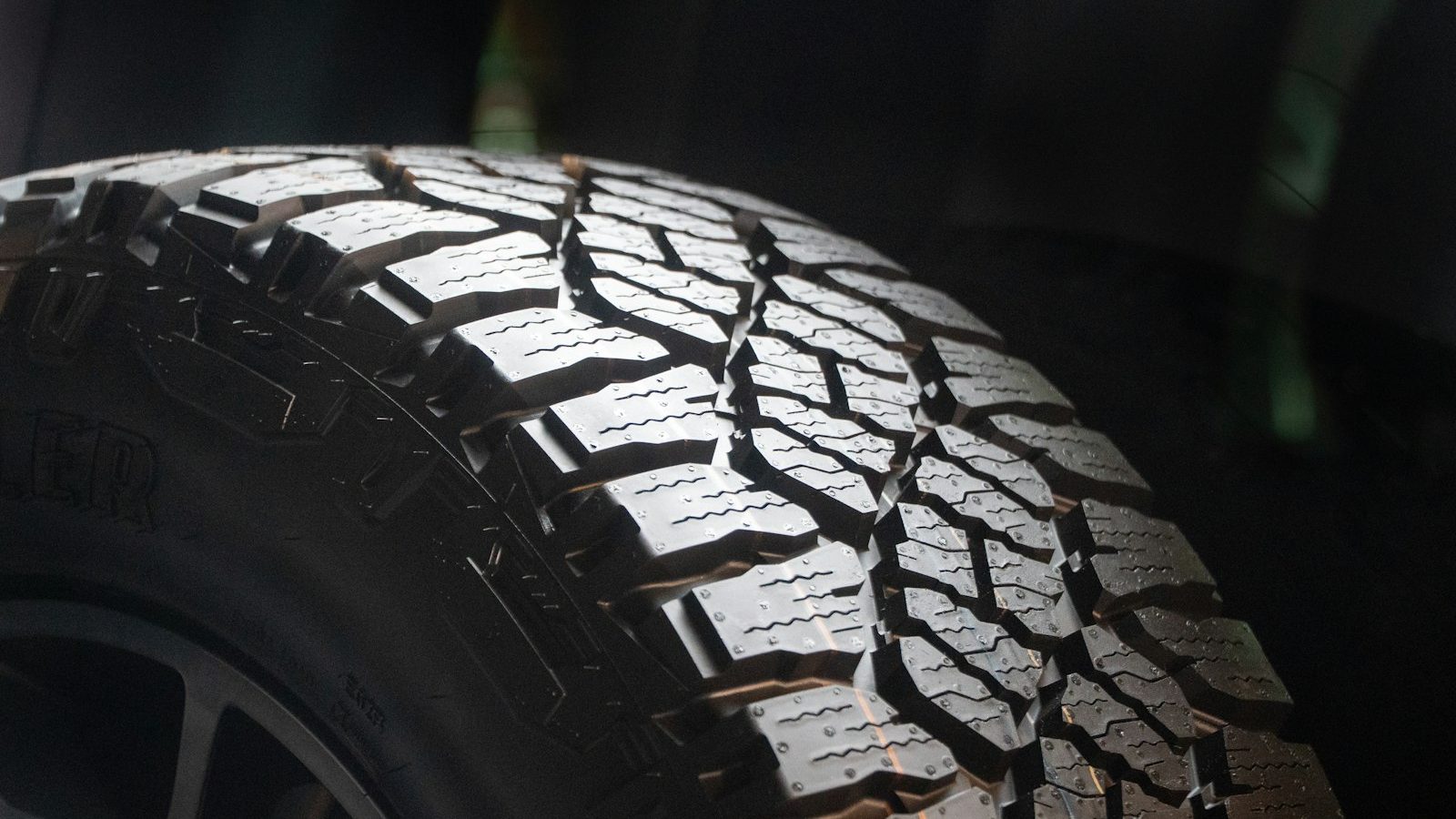
Sipes are the thin slits cut across tread blocks. They add biting edges that grip wet pavement, packed snow and ice, and they let the block flex slightly so it conforms to the surface. All-terrains and highway tires carry a lot of them. BFGoodrich credits full-depth 3D sipes, along with a new compound, for letting the All-Terrain T/A KO3 carry the three-peak mountain snowflake, and Falken says the Wildpeak A/T4W uses full-depth sipes so the edges keep working as the tread wears. Mud-terrains usually carry far fewer, because their lugs are built stiff for rock and mud.
Stone ejectors
These are the small raised ridges or nubs molded into the bottom of the grooves. Gravel gets wedged between tread blocks, and if it stays there, every revolution pushes it deeper toward the casing. Ejectors push stones back out before they can drill in. Toyo, for example, calls out stone and mud ejectors in the grooves of its Open Country R/T.
Sidewall lugs and sidewall construction
On A/T, R/T and M/T tires, tread-like lugs extend from the shoulder down onto the sidewall. They do two jobs. They add grip when you're aired down in ruts or climbing rock, where the sidewall bulges and contacts the terrain, and they add rubber in the area most likely to get cut. Hybrids and mud-terrains have the biggest sidewall lugs. Some all-terrains now carry them too: BFGoodrich describes extended shoulder rubber running down the KO3's sidewall and a split- and bruise-resistant sidewall compound.
Construction matters as much as rubber. Falken offers its three-ply DURASPEC sidewall on select A/T4W sizes. A three-ply sidewall is harder to puncture, though it also flexes a little less when aired down.
Rubber Compound, Tread Life and Road Noise
Compound is the part you can't see. All-terrain compounds are formulated to balance long highway life with cut and chip resistance. Mud-terrain compounds lean toward toughness against rock cuts and chipping, and the big, unsupported lugs tend to wear unevenly if you skip rotations. Rotate every tire at the interval its maker specifies. With an M/T, skipping it is how a set ends up cupped and loud halfway through its life.
Treadwear warranties are a decent signal of how a maker expects a tire to wear. Falken, for instance, backs the A/T4W with up to 60,000 miles in LT sizes and up to 65,000 in standard sizes. Compare warranties across the types you're shopping and you'll usually see the pattern: more void, fewer promised miles.
Noise follows void. Highway tires are quietest, all-terrains range from nearly silent to a mild hum, hybrids are louder, and mud-terrains howl at highway speed and get louder as they wear. Tire makers vary block sizes around the tread to spread the noise across different pitches, which helps, but it can't make a mud tire quiet.
Shop tip
Off-road, tire pressure often matters as much as tread pattern. A good all-terrain aired down properly can outwork a mud-terrain left at highway pressure on a lot of trails. Our airing-down guide has starting numbers by terrain.
Wet and Snow Traction: Which Tires Carry the 3PMSF Symbol
Nearly every off-road tire wears the M+S (mud and snow) marking. That's based on tread geometry alone. The symbol that means something in winter is the three-peak mountain snowflake (3PMSF), which a tire earns by scoring a traction index of at least 110 against a reference tire rated 100 in a standardized acceleration test on medium-packed snow. It doesn't test braking, cornering or ice, so it isn't a substitute for a dedicated winter tire on ice. It does separate tires that grip snow from tires that merely look like they should.
Here's how some current, widely sold models line up:
- BFGoodrich All-Terrain T/A KO3: carries 3PMSF.
- Falken Wildpeak A/T4W: carries 3PMSF.
- Nitto Ridge Grappler (a hybrid): M+S rated, no 3PMSF.
- Toyo Open Country R/T Trail (a hybrid): not 3PMSF rated.
- BFGoodrich Mud-Terrain T/A KM3: M+S branded, no 3PMSF.
That list reflects the general rule. Many leading all-terrains now carry the snowflake, while hybrids and mud-terrains mostly don't. Always confirm on the sidewall or the maker's spec sheet for the exact size you're buying.
On wet pavement, siping and rubber-to-road contact win, so highway and all-terrain tires stop and turn better than mud-terrains. In deep, unplowed snow, an aggressive tire can paddle through, but on packed snow and ice the mud-terrain's big smooth lug faces and few sipes leave it at a real disadvantage. If you drive icy roads daily, weigh that more heavily than how the tire looks on the truck.
Weight, Rolling Resistance and the Fuel Economy Penalty
Aggressive tires are heavy. Tire Rack lists BFGoodrich's KM3 at 75 lb in 35x12.50R17 and 67 lb in LT285/70R17, both Load Range E. Stock-size passenger-rated highway tires are usually far lighter. That weight is unsprung and rotating, so your truck has to accelerate it, stop it and control it over bumps every mile.
Rolling resistance adds to the bill. Deep lugs flex and squirm, and heavy LT casings take more energy to deform with every revolution. A National Research Council report found that a 10 percent cut in rolling resistance improves fuel economy by 1 to 2 percent; aggressive LT tread pushes the number the other way. Go up in diameter at the same time and you also change your effective gearing, which shows up as sluggish acceleration, more downshifting when towing and a speedometer that reads low. Our regearing guide covers when new gears make sense, and our tire size guide shows how to calculate the diameter change. To compare a bigger size against your stock tires before you buy, run the numbers here:
Load Range C vs. E for All-Terrain and Mud-Terrain Tires
Most off-road tires come in more than one load range, and the choice matters as much as the tread. BFGoodrich sells the KO3 in C, D and E depending on size, and Falken added heavy-duty LT sizes to the A/T4W for towing.
- Load Range C (the old 6-ply rating, 50 psi max on LT-metric sizes) is lighter and more supple. It rides better on a midsize or a lightly loaded half-ton, and it conforms well when aired down. It's the right call if you don't tow heavy or carry big payloads.
- Load Range E (the old 10-ply rating, typically 80 psi max) carries more weight, and its heavier casing tends to shrug off sidewall damage better. Heavy-duty pickups generally need it to meet their axle ratings, and it's the sensible choice for a half-ton that tows near its limit or runs a loaded overland build.
The most common mistake is running E-range tires on a light truck at the sidewall maximum. That rides like a wagon with wooden wheels. Use the tire maker's load and inflation tables to set a pressure that carries your real axle loads, which on a lightly loaded half-ton is usually far below 80 psi. If you're weighing capacity numbers, our towing and payload explainer shows where tire ratings fit.
Who Should Buy Which Tire
Highway tires are for trucks that live on pavement: commuting, road trips and towing on paved roads. You get the quietest ride, the best wet braking and the longest wear.
All-terrains are the right answer for most truck owners. Gravel roads, hunting trails, the occasional rocky two-track, beach access and winter commuting are all in their wheelhouse. If snow matters, shop the ones with the snowflake.
Hybrid or rugged-terrain tires fit owners who hit real trails a couple of weekends a month and still drive to work. You get more sidewall bite and a tougher look, and you pay with some noise and weight. Check the snow rating closely, because most don't carry 3PMSF.
Mud-terrains make sense if you regularly drive in mud, clay or serious rock, or if your truck is primarily a trail rig. Here's the honest ledger:
Pros
- Best self-cleaning in mud and clay
- Big sidewall lugs for grip and cut protection when aired down
- Tough, chip-resistant lugs on sharp rock
- Deep tread to start with
Cons
- Loud at highway speed, louder as they wear
- Weaker wet-pavement and ice traction; usually no 3PMSF
- Heavy, with a measurable fuel economy penalty
- Uneven wear if rotations slip
Extreme and rock tires belong on dedicated trail rigs, ideally ones that arrive at the trail on a trailer.
Pick the tire for the miles you drive every week, then air it down for the miles you brag about.
Tires are only part of the traction picture. Driving technique does as much work, and our off-road driving basics cover how to use whatever tread you choose. If you're building a truck for long trips, the overlanding build plan covers how tires fit with weight, suspension and gear.
Frequently asked questions
Are all-terrain tires good in snow?
Some are very good. Look for the three-peak mountain snowflake symbol, which means the tire passed a standardized acceleration test on packed snow. Current examples include the BFGoodrich All-Terrain T/A KO3 and the Falken Wildpeak A/T4W. The symbol doesn't cover ice, so a dedicated winter tire still wins on icy roads.
Are mud-terrain tires bad for daily driving?
They're livable, but you pay for them every day. Mud-terrains are louder, heavier and weaker on wet pavement and ice than all-terrains, and they usually wear faster and less evenly. If most of your miles are pavement and your off-roading is gravel or light trail, an all-terrain or hybrid tire is the better daily choice.
What is a hybrid or rugged-terrain tire?
It's a tire that blends an all-terrain center tread with mud-terrain shoulders and sidewall lugs. Examples include the Nitto Ridge Grappler and Toyo Open Country R/T. They drive closer to an all-terrain on pavement while adding sidewall bite for rock and ruts. Most don't carry the three-peak mountain snowflake, so check before buying for winter.
Do mud tires lower gas mileage?
Yes. Aggressive LT tires are heavier and have higher rolling resistance, and both cost fuel. A National Research Council report found a 10 percent cut in rolling resistance improves fuel economy 1 to 2 percent, so the reverse works against you. Going up in diameter at the same time changes effective gearing and adds to the penalty.
Should I get Load Range C or E all-terrain tires?
Choose by weight and use. Load Range C is lighter and rides softer, which suits midsize trucks and lightly loaded half-tons. Load Range E carries more and resists sidewall damage better, which suits heavy-duty pickups, heavy towing and loaded overland builds. Either way, set street pressure from the tire maker's load tables, not the sidewall maximum.
Sources & further reading 11
- bfgoodrichtires.combfgoodrichtires.com/auto/tire-highlights/all-terrain-t-a-ko3
- falkentire.comfalkentire.com/wildpeak/at4w
- toyotires.comtoyotires.com/product/open-country-rt/
- gearjunkie.comgearjunkie.com/motors/toyo-open-country-r-t-trail-tire-review
- tirerack.comtirerack.com/tires/nitto-ridge-grappler
- simpletire.comsimpletire.com/learn/compare/toyo-open-country-a-t-iii-vs-nitto-ridge-grappler-tires
- tirerack.comtirerack.com/tires/bfgoodrich-mud-terrain-t-a-km3
- tirerack.comtirerack.com/tires/Spec.jsp?tireMake=BFGoodrich&tireModel=Mud-Terrain+T%2FA+KM3
- tirerack.comtirerack.com/upgrade-garage/what-is-the-threepeak-mountain-snowflake-symbol
- nationalacademies.orgnationalacademies.org/read/11620/chapter/2
- tirereview.comtirereview.com/tire-types-and-load-capacity/
Specs and ratings change between model years and configurations. Confirm numbers for your exact truck in the owner's manual and on the door-jamb labels.