Leveling Kit vs. Lift Kit vs. Body Lift: What Each One Really Does
A leveling kit, a suspension lift and a body lift all make room for bigger tires, but they raise different parts of the truck and carry very different hidden costs.
The short version
- Leveling kits raise only the front, typically 1.5 to 2.5 in, to remove factory rake; the rear stays put.
- Suspension lifts raise the frame on both ends; good kits correct ball-joint, CV and alignment geometry.
- Body lifts add tire room, not ground clearance: the frame, axles and skid plates don't move.
- Every lift needs an alignment and headlight re-aim; bigger tires also mean speedometer and gearing fixes.
- Magnuson-Moss bars tying a warranty to branded parts, but damage caused by a lift can still be denied.
A leveling kit raises the front of your truck to match the rear. A suspension lift raises the whole chassis and usually changes its geometry, while a body lift raises only the cab and bed off the frame, making room for bigger tires but adding no ground clearance at all. Here's how each one works, what it really costs beyond the parts, and how to pick the right one for the tires you want.
What each kit actually raises
Every lift conversation comes down to one question: which parts of the truck move up, and which stay put. Get that straight and most of the confusion goes away.
- Leveling kit: lifts the front of the truck, typically 1.5 to 2.5 in, so it sits level with the rear. The rear doesn't change.
- Suspension lift: lifts the frame (and everything bolted to it) relative to the axles, front and rear. Heights run from about 2 in to 6 in and beyond.
- Body lift: lifts the cab and bed relative to the frame using spacers at the body mounts. The frame, axles, differentials and skid plates stay exactly where they were.
Leveling kit vs body lift vs suspension lift
Stock: factory rake
Most pickups sit an inch or two lower in front so the truck levels out with weight in the bed or on the hitch.
- Tire room
- Factory size
- Clearance
- Factory
Leveling kit: front only
Strut spacers or torsion-key adjustment raise the front 1.5–2.5 in to remove the rake. Cheap and simple, but it steepens CV and ball-joint angles on IFS trucks.
- Typical cost
- Low
- Fits
- Usually one tire size up
- Clearance under diff
- Unchanged
Body lift: body up, frame stays
Spacers lift the body off the frame, usually 1–3 in, to make room for larger tires. Suspension geometry is untouched, but there is a visible gap and more work around steering shafts, bumpers and wiring.
- Tire room
- More
- Ground clearance
- Only from taller tires
Suspension lift: the whole truck
New springs, coilovers, control arms or knuckles raise the frame and body together. Best result, most cost. Solid-axle clearance under the diff still only grows with taller tires.
- Typical range
- 2–6 in
- Plan for
- Alignment, gearing, brakes, driveline angles
The one thing that raises everything, including the axle housings, is a taller tire. A solid axle only gains clearance through tire size, and the gain is half the diameter change: going from a 33-in tire to a 35-in tire lifts the differential about 1 in. Keep that in mind when a kit's advertised height sounds generous.
Leveling kits: removing the factory rake
Most pickups leave the factory nose-down, with the front sitting an inch or two (sometimes more) lower than the rear. That rake is deliberate. When you drop a load in the bed or hang a trailer on the hitch, the rear squats and the truck ends up roughly level instead of pointing its headlights at the treetops. Plenty of owners never tow heavy, don't like the look, and want room for a slightly larger tire. That's the leveling kit customer.
Strut spacers on coilover IFS trucks
Most current half-tons and midsize trucks with independent front suspension (IFS) use a coilover strut up front. The common leveling kit is a steel or aluminum spacer that bolts between the top of the strut assembly and its upper mount. The factory spring and shock stay in place, so the ride is close to stock. The catch is downtravel: the truck now sits closer to the shock's full extension, so the front has less room to droop before it tops out.
A second style, the preload spacer, sits on top of the spring inside the strut assembly and compresses it. Installing one means taking the coilover apart, and that means compressing a loaded spring.
Coil springs store serious energy
Never unbolt the top nut of a strut assembly without the spring properly held in a quality strut spring compressor. A spring that lets go can cause severe injury. Top-mount spacers avoid this job entirely, which is one reason they're the more popular design.
Torsion key "cranking" on older IFS trucks
Torsion-bar front ends (GM half-tons through the 2018 model year, many GM heavy-duty trucks, and 1997–2003 F-150 4x4s, among others) set front ride height with an adjuster bolt that rotates the torsion key. Turn the bolts in and the front comes up. That's "cranking the bars," and it costs nothing but time and an alignment.
It isn't free in other ways. The torsion bar's spring rate doesn't change, but the suspension now sits closer to its droop limit, so the ride feels harsher as the wheel tops out over dips. The CV axles and upper ball joints work at steeper angles, too. Aftermarket leveling keys are clocked differently so you can get the height without running the adjuster bolt to the end of its threads. Turn both sides the same amount, measure ride height at the wheel openings side to side, and get it aligned before you drive it much.
Solid-axle trucks
On trucks with a solid front axle and coil springs, such as the Ram 2500/3500 and the Jeep Gladiator, leveling usually means a coil spacer or slightly taller springs. As the axle drops away from the frame, the track bar swings through an arc and pulls the axle sideways, so bigger level kits include an adjustable track bar to recenter it.
Suspension lifts: from spacer kits to bracket lifts
A suspension lift raises both ends. The range runs from a few bolt-on spacers to a weekend of cutting and bolting in new crossmembers, and what you get for the money varies just as widely.
Spacer lifts
A taller front strut spacer plus rear lift blocks or an add-a-leaf gives you a 2 to 3 in spacer lift. It's the cheapest way to get the whole truck up, and it keeps the factory shocks. That's also its weakness: those shocks were valved and sized for stock height, and they now spend their life closer to full extension.
Coilovers and upper control arms
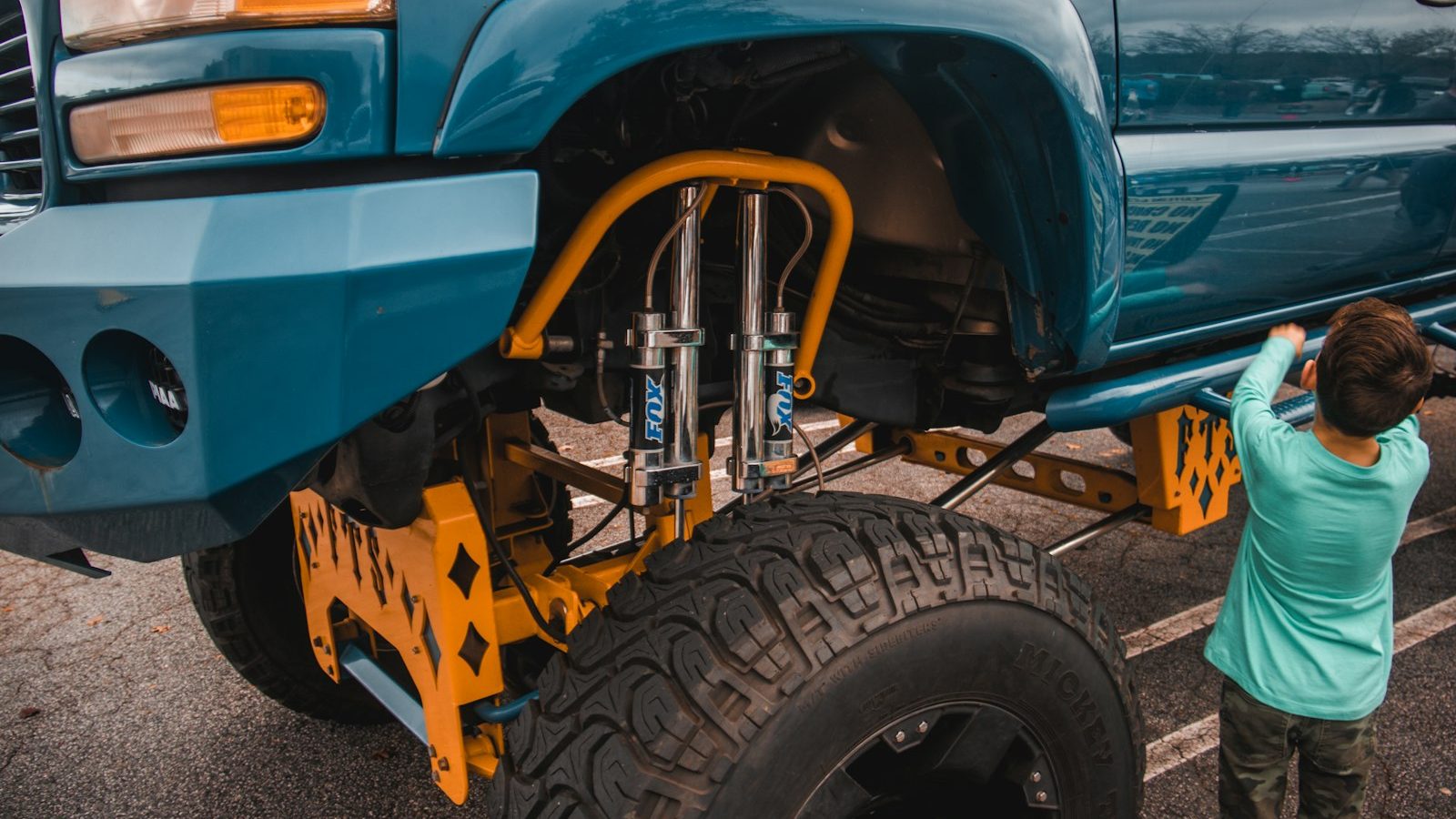
The next step up replaces the factory front struts with complete aftermarket coilovers, often with larger shock bodies, remote reservoirs and threaded collars for adjustable ride height. Good kits pair them with tubular upper control arms (UCAs). New UCAs correct the upper ball-joint angle so it doesn't bind at full droop, add caster to bring the alignment back into spec, and clear the fatter coilover body.
Knuckle, spindle and drop-bracket kits
Past roughly 4 in on an IFS truck, you can't just stretch the struts. Taller replacement knuckles (spindles) move the wheel hub lower relative to the control arms, which keeps the arm and tie-rod angles close to stock. Most big IFS kits pair those knuckles with drop brackets that lower the lower control arm pivots and the front differential, often with new crossmembers. This is how 4 to 6 in lifts, and taller ones, stay drivable.
Understand what you're buying, though. The brackets and crossmembers hang below the frame, so the lowest point under the front of the truck doesn't rise nearly as much as the fender does. The tires make up some of the difference.
Rear blocks, add-a-leafs and new leaf packs
- Lift blocks sit between the leaf pack and the axle, with longer U-bolts. They're cheap and simple. Taller blocks give the axle more leverage to twist the springs (axle wrap), which shows up as wheel hop under hard launches and while towing.
- Add-a-leafs slide an extra leaf into the pack for 1 to 2 in of lift and a firmer ride.
- New leaf packs are the best ride and articulation option and the most expensive. They're the right call on trucks that carry weight or see real trail use.
Solid-axle coil trucks
Lifting a coil-sprung solid axle means longer springs and shocks, plus the parts that keep the axle where it belongs: an adjustable track bar, adjustable control arms or cam bolts to restore caster and pinion angle, longer brake lines, sway bar links and bump stop spacers. Some setups also need steering correction such as a drop pitman arm. Leaving those out is how you get a truck that wanders and shakes.
Body lifts: tire clearance, not ground clearance
A body lift replaces or stacks spacers (pucks) at each body mount, usually 1 to 3 in. The cab and bed rise off the frame; nothing else moves. Your suspension geometry, CV angles and alignment stay exactly as the factory set them, which is the whole appeal. What you gain is room in the wheel wells.
What you don't gain is ground clearance. The frame, differentials, transfer case, fuel tank and skid plates sit at the same height they always did. The bumpers bolt to the frame, so they stay low and leave a visible gap unless you buy relocation brackets. Depending on the truck, the radiator and fan shroud, steering shaft, shifter linkages, fuel filler neck, wiring and hoses all need attention. Some states cap body lift height, so check local rules before you order.
Leveling kit vs. lift kit vs. body lift at a glance
| Leveling kit | Suspension lift | Body lift | |
|---|---|---|---|
| Typical height | 1.5–2.5 in (front only) | 2–6+ in (both ends) | 1–3 in |
| What moves up | Front of chassis and body | Frame, body, IFS front diff | Cab and bed only |
| Ground clearance gain | Small, front only | Yes, except under solid axles | None |
| Geometry changes | Mild (CV, ball joint, alignment) | Significant; good kits correct it | None to suspension |
| Ride quality | Near stock to slightly firmer | Worse to better, kit dependent | Unchanged |
| Relative cost | $ | $$ to $$$$ | $ to $$ |
| Best for | Stance, one tire size up | Big tires, real trail use | Tire room on a budget |
The hidden costs: CV angles, ball joints, alignment and vibration
The kit price is the down payment. The real bill shows up in parts that now work harder than they were designed to.
CV and ball-joint angles
On an IFS 4x4, the front CV axles run at an angle between the frame-mounted differential and the wheel hub. Raise the truck and that angle gets steeper at ride height. Steeper angles wear CV joints faster, tear boots, and cause clicking or vibration. The upper ball joint also runs closer to its travel limit, which is why better kits include UCAs. Some leveling and lift kits add differential drop spacers to reduce the CV angle; others add bump stop spacers or limit straps so the joints never reach full droop.
Alignment
Any change in ride height moves camber, caster and toe. Get a proper alignment after every leveling kit or lift, not just the big ones. If the shop runs out of adjustment, you need aftermarket UCAs, cam kits or adjustable control arms. Driving on a bad alignment eats tires quickly.
Driveline vibration
Lifting the rear changes the driveshaft and pinion angles. Universal joints like small, matched working angles; push them past that and you get a vibration that builds with speed. The fixes include tapered shims under the leaf springs, carrier bearing drop spacers on two-piece driveshafts, and on taller lifts, a longer or double-cardan driveshaft. Also check slip yoke engagement, because the lift pulls the yoke farther out of the transmission or transfer case.
Bigger tires: brakes, steering, speedometer and gearing
People lift trucks to fit tires, and tires are where the rest of the cost hides. A taller, heavier tire has more rotating mass and a longer lever arm against your brakes, so stopping distances grow and the brakes run hotter. Steering components such as tie-rod ends, idler arms and steering boxes see more load, especially with aggressive tread and aired-down pressures. On heavier builds, a brake upgrade isn't a luxury.
Taller tires also make the speedometer read low and effectively lengthen your axle ratio. A 35-in tire on a truck calibrated for 31s turns about 11 percent fewer revolutions per mile, so the truck feels sluggish, the transmission hunts for gears on grades, and your odometer undercounts. Use the calculator below to see the difference for your sizes, and read our guide to reading a tire size if the numbers on your sidewall look like a secret code.
Most modern trucks can have the tire size reprogrammed with a dealer tool or a reputable programmer, which corrects the speedometer and keeps the ABS and stability control working with accurate wheel speeds. Getting the performance back is a different job. That's covered in our guide to regearing after bigger tires.
Headlights, bumpers, sensors and the law
Leveling a truck raises the headlights more than the tail, so the beams now point higher. Re-aim them using the procedure in your owner's manual; oncoming drivers will appreciate it. And when you hook up a trailer to a leveled truck, the rear squats and the nose points up even further.
Many late-model trucks have front radar and camera sensors for adaptive cruise, automatic emergency braking and lane keeping. A change in ride height changes where those sensors look. Check the manufacturer's service information for recalibration requirements after a lift or level, and have it done if required.
Bumper and frame height limits vary by state, as do rules on tire coverage and headlight height. A mild level almost never runs afoul of them. A big lift on big tires might, so check before you buy the kit, not after the inspection.
Warranty and the Magnuson-Moss Act
The Magnuson-Moss Warranty Act is widely misquoted in both directions. Here's what it actually says. A warrantor can't condition your warranty on using a particular brand of parts or service unless those parts or services are provided free, or the Federal Trade Commission grants a waiver. So installing a lift kit does not, by itself, void your entire warranty.
What the manufacturer can do is deny a claim for damage the modification caused. A lifted truck with a failed CV axle, a worn ball joint, a bad wheel bearing or a driveline vibration is exactly where those arguments happen, and the dealer will look hard at anything the kit touched. Unrelated parts, like the radio and the power windows, should stay covered. The front end may become a negotiation.
Protect yourself
Keep receipts, kit instructions and alignment printouts. Ask the dealer's service department how it handles your specific kit before you install it. Some automakers sell leveling or lift kits through their own accessory programs with their own coverage terms, so read those terms carefully. This is general information, not legal advice.
How to choose the right lift for your truck
Pick the tire first. Then buy the least lift that fits it.
- Choose the tire size. Decide what tire you actually need for your terrain, then look up what it takes to clear that size on your specific truck. Our all-terrain vs. mud-terrain comparison helps with the tread choice.
- Be honest about use. A daily driver that tows gets the most out of a mild level and a modest tire. A trail rig that sees ledges and ruts needs real suspension travel, better shocks and ground clearance, which means a quality suspension lift.
- Budget for the extras. Alignment, headlight aim, tire size programming and possibly sensor calibration are part of every job. Bigger tires may add a regear and brake upgrades.
- Buy geometry, not height. A 3 in kit with correct UCAs, shocks and driveline fixes beats a 6 in kit that leaves the ball joints bound up. Height you can't drive on is just a photo.
- Check what the lift does off-road. More height helps your approach, departure and breakover angles, but it also raises the center of gravity. Drive it accordingly on side slopes.
Leveling kit pros
- Cheapest way to fit one tire size up on many trucks
- Near-stock ride with top-mount spacers
- Bolt-on install for most home mechanics
Leveling kit cons
- Loses the rake that keeps a loaded truck level
- Reduces front downtravel and steepens CV angles
- Little real gain in ground clearance
Frequently asked questions
Does a leveling kit void my truck's warranty?
Not by itself. The federal Magnuson-Moss Warranty Act bars a manufacturer from conditioning your warranty on using its own branded parts unless they're provided free. The manufacturer can still deny a specific claim if the leveling kit caused or contributed to the failure, such as a worn CV axle or ball joint. Keep receipts and alignment records, and ask your dealer how it handles your kit before installing it.
Does a body lift increase ground clearance?
No. A body lift raises the cab and bed off the frame with spacers at the body mounts. The frame, axles, differentials, fuel tank and skid plates stay at the same height, so ground clearance doesn't change. What you gain is room in the wheel wells for taller tires, and taller tires are what actually raise the axles and add clearance.
Do I need an alignment after installing a leveling kit?
Yes. Raising the front of the truck changes camber, caster and toe, even with a small 1.5 to 2 in spacer. Driving on a bad alignment wears tires quickly and can make the truck pull or wander. Have it aligned right after installation, and if the shop runs out of adjustment range, you may need aftermarket upper control arms or a cam kit.
Is a leveling kit bad for towing?
A leveling kit doesn't add any capacity. The factory rake exists so the truck sits roughly level with weight on the hitch. Once it's leveled, a heavy trailer makes the rear squat and the nose point up, which unloads the front axle and aims the headlights high. Stay within the manufacturer's ratings, use a weight-distributing hitch where the owner's manual calls for one, and re-aim the headlights.
Should I get a leveling kit or a lift kit?
Start with the tire you want. If a leveling kit clears it on your truck and you mostly drive on pavement or easy trails, leveling is the cheaper, simpler choice. If you need tires two or more sizes up, more ground clearance, or better suspension travel for real trail use, a quality suspension lift with corrected geometry and better shocks is worth the extra money.
Sources & further reading 5
- law.cornell.edulaw.cornell.edu/uscode/text/15/2302
- ftc.govftc.gov/business-guidance/resources/businesspersons-guide-federal-warranty-law
- ftc.govftc.gov/news-events/news/press-releases/2018/04/ftc-staff-warns-companies-it-illegal-condition-warranty-coverage-use-specified-parts-or-services
- media.stellantisnorthamerica.commedia.stellantisnorthamerica.com/view-spec.do?id=27251
- media.stellantisnorthamerica.commedia.stellantisnorthamerica.com/view-spec.do?id=27014
Specs and ratings change between model years and configurations. Confirm numbers for your exact truck in the owner's manual and on the door-jamb labels.