Off-Road Recovery Gear: The Essential Kit, Tier by Tier
Rated recovery points, the right rope, shackles, a winch sized to your truck, and the checklist that keeps everyone clear when the line comes tight.
The short version
- Only hook to rated recovery points. A hitch ball or tie-down loop can break and become a projectile.
- Kinetic rope stretches roughly 20-30%; static straps are for steady pulls only, and hooked tow straps don't belong in recovery.
- Size a winch to at least 1.5x the truck's GVWR, and remember rated pull applies only to the first layer of line.
- Know whether a rating is WLL or minimum breaking strength, and remember the weakest link sets the limit.
- Keep bystanders at least 1.5x the line length away, never in line with the pull, and hang a damper on the line.
Most trail recoveries go wrong because of what the truck is attached to, not how hard somebody pulls. Build your kit around rated connection points and gear with known ratings, learn the few techniques that keep stored energy under control, and you can get a stuck truck moving without sending hardware through anybody's windshield. Here's what to carry, in the order to buy it, and how to use it.
Start With Rated Recovery Points, Not the Tow Ball
Every recovery is a chain: truck, recovery point, shackle, strap or line, shackle, recovery point, truck. The weakest link sets the limit, and on a lot of stock pickups that's whatever the owner grabbed in a hurry.
A rated recovery point is designed for recovery loads, bolted to the frame with the hardware its maker specifies, and carries a published rating. Factory front hooks vary: some owner's manuals approve them for recovery, some only for pulling the truck onto a trailer. Read the manual for your exact truck before you trust what's under the bumper.
Two things are never recovery points. A hitch ball is built for tongue weight and the steady pull of a trailer, not the shock load of a stretching rope, and a ball that shears under load becomes a projectile. A tie-down loop is the stamped eye the factory uses to strap the truck down for shipping. It was made to hold the truck on a rail car, not drag it out of a bog.
For the rear, use a purpose-built, rated receiver shackle mount in a frame-mounted receiver, retained by a proper hitch pin. The ball mount comes out first. Up front, if you're upgrading to steel, pick a bumper with integrated rated shackle mounts; our bumper and armor guide covers what to look for.
Never the ball, never a tie-down
Remove the ball mount before any recovery, and never hook to a tie-down loop, suspension arm, axle tube or plain bumper bracket. If either vehicle lacks a rated point, stop and solve that first. No technique makes an unrated attachment safe.
The Minimum Kit: Straps, Shackles, Digging Tools and Air
This gear rides in the truck on every trail run, easy ones included.
Kinetic rope, recovery strap or static strap
- Kinetic recovery rope. Double-braided nylon that stretches roughly 20 to 30 percent. The recovery truck builds a little momentum, the rope stores it as it stretches, then hands it back as a smooth, strong tug. It's the best tool for a kinetic pull and the gentlest on both trucks.
- Nylon recovery (snatch) strap. Flat webbing that stretches around 15 percent, per BFGoodrich's recovery guide. It works for kinetic pulls but delivers a sharper jolt.
- Static strap. Usually polyester, with very little stretch. It's for steady pulls only: extending a winch line or towing a vehicle that can roll. Use one for a yank-style recovery and the shock goes straight into both frames.
Size ropes to the truck using the maker's chart. Bubba Rope suggests a breaking strength of 3 to 4 times the weight of the vehicle being recovered. Too light and it overstretches or breaks; too heavy and a lighter truck can't stretch it enough to work.
Why hooked tow straps don't belong in recovery
The cheap tow strap with a stamped hook sewn into each end might be the most dangerous thing in the auto-parts aisle. Open hooks slip off, straighten or snap, and they invite people to hook onto whatever's handy. When a stretched strap lets go, the steel hook is what flies. Cut the hooks off or leave that strap in the barn.
Soft shackles vs steel D-rings
Steel bow or D-ring shackles are cheap and nearly indestructible. The 3/4-inch size is common for trucks; a quality one such as Crosby's G-209 carries a 4.75-ton working load limit in that size, with a minimum ultimate strength six times higher. Thread the pin in fully, back it off about a quarter turn so it can't seize, and load the shackle in line with its body, not across the pin.
Soft shackles are loops of synthetic rope, usually the same UHMWPE fiber family as winch line, closed with a knotted button.
Pros
- Light enough for a door pocket
- Less stored energy than steel if something fails
- No pin to seize or lose
Cons
- Cut by sharp edges and rough welds; needs radiused points
- Abrasion and heat degrade the fiber
- Lower breaking strength than heavy steel; Warn lists 29,700 to 36,000 lb for its versions
Carry at least two of each: steel for sharp or rough points, soft everywhere else.
Shovel, traction boards and gloves
The shovel is the most underrated recovery tool you'll own. Clearing dirt from in front of the tires and from under the frame and differentials often gets a truck moving with no pulling at all. Traction boards go in front of or behind the tires in sand, mud and snow. Dig a shallow ramp, wedge the board tight against the tread, and drive on with low wheel speed, since spinning tires melt the teeth. Gloves means heavy leather, worn every time you touch a strap, shackle or winch line; steel cable in particular grows broken strands that slice skin.
Tire deflator and compressor
Airing down lengthens the tire's footprint, and a truck stuck at highway pressure often drives out at trail pressure. A screw-on deflator with a preset stop does four tires in minutes, and the compressor gets you back to road pressure before highway speeds. Our airing-down guide covers pressures by terrain.
WLL vs Minimum Breaking Strength: How to Read Gear Ratings
Minimum breaking strength (MBS) is the load at which a new, undamaged item is expected to fail in testing. Straps and ropes are usually sold by MBS, so a "30,000 lb strap" broke at or above 30,000 lb when new.
Working load limit (WLL) is the most the maker says the item should carry in normal service: MBS divided by a design factor. On Crosby's G-209 shackles that factor is 6:1.
Compare like with like: a shackle's WLL and a strap's MBS are different kinds of numbers. The weakest link, often the recovery point, sets the limit, and cuts, abrasion, sun, grit and knots all reduce strength. Never knot a strap or rope, and retire anything with cut fibers, torn stitching or a bent pin.
The Next Tier: Winch, Tree Saver, Snatch Block and Damper
A winch turns "we need another truck" into "give me ten minutes." It's also the most powerful tool in the kit and deserves the most respect.
How big a winch you need
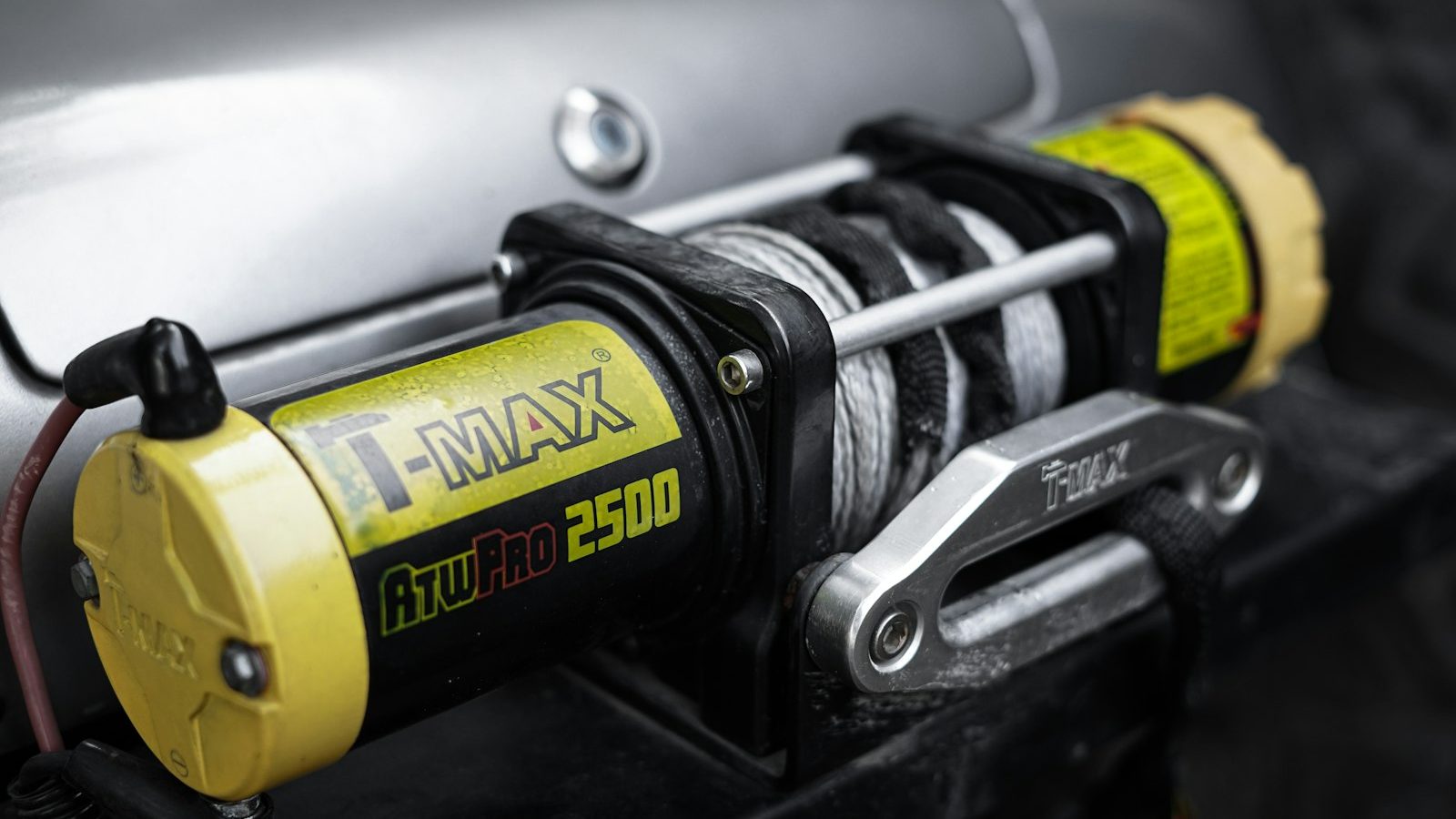
Warn's rule: multiply the truck's gross vehicle weight rating (GVWR, on the door-jamb label) by 1.5 for the minimum rated line pull. A 7,000 lb GVWR calls for at least 10,500 lb, which in practice means the 12,000 lb class. A truck buried in mud or pointed up a grade takes far more force to move than it weighs, and rated pull applies only to the first layer of line on the drum; Factor 55 puts the loss at roughly 10 percent per added layer. Our GVWR and payload explainer covers the ratings.
Synthetic line over steel cable
Synthetic line is lighter, floats, has no sharp broken strands, and stores less energy than steel when it breaks. It's vulnerable to abrasion and heat, wants a smooth aluminum hawse fairlead, and needs to be kept clean. Steel cable tolerates dragging over rock but needs gloves and a damper even more.
Tree saver, snatch block and line damper
- Tree saver. A wide, low-stretch strap that turns a tree or big rock into an anchor. Warn says to always use one or a choker chain on the anchor. Wrap it low on the trunk, join both ends with a shackle, and never wrap winch line around a tree.
- Snatch block. A pulley that opens to accept the line. Running the line to a block at the anchor and back to the truck roughly doubles pulling force, halves line speed, and roughly doubles the load on the anchor and the truck's recovery point, so everything in that system needs a matching rating.
- Line damper. A weighted blanket or bag hung over the line so a failure drives it toward the ground instead of whipping. Warn says to place it midway between winch and anchor before the line is under tension.
High-lift jack cautions
Hi-Lift's own instructions list a 4,660 lb maximum rated load, say to keep your head out of the handle's path, chock the opposite wheel, and clip the handle upright before moving the reversing latch. They also say plainly not to use the jack to support or stabilize a load. On most modern pickups it needs a steel bumper or sliders to lift from.
A jack is not a jack stand
Never put any part of your body under a truck held up by any jack, a high-lift least of all. The handle can kick hard enough to break a jaw or wrist if the load shifts. If you haven't been trained on one, leave it on the rack and use the shovel.
Trail Communication: GMRS Radios and Satellite Messengers
GMRS radios are the default trail radio in the US, and transmitting requires an FCC license. It costs $35, has no exam, lasts 10 years, and covers family members of any age; the applicant must be 18 or older. Mobile GMRS radios can run up to 50 watts on the main channels, which reaches much farther than a handheld. License-free FRS radios are limited to much lower power.
Satellite messengers cover you beyond radio range. Garmin's inReach devices send texts and SOS messages by satellite with an active subscription, and SOS alerts go to Garmin Response, a staffed 24/7 center. iPhone 14 and later can text emergency services by satellite in the US when there's no cell or Wi-Fi coverage and you have a clear view of the sky. Either way, leave a trip plan with someone at home.
Recovery Gear at a Glance: Tiers and Rough Prices
| Item | Tier | Job | Rough price |
|---|---|---|---|
| Rated recovery points / receiver shackle mount | Minimum | Safe attachment to the frame | $50–$200 |
| Kinetic recovery rope | Minimum | Kinetic pulls | $70–$300 |
| Soft shackles (pair) | Minimum | Light connections | $30–$80 |
| 3/4-in steel bow shackles (pair) | Minimum | Sharp or rough points | $20–$60 |
| Shovel | Minimum | Digging out | $30–$100 |
| Traction boards (pair) | Minimum | Sand, mud and snow self-recovery | $60–$350 |
| Leather gloves | Minimum | Hand protection | $15–$40 |
| Tire deflator | Minimum | Fast airing down | $20–$100 |
| 12V air compressor | Minimum | Airing back up | $100–$700 |
| Winch with synthetic line | Next tier | Self-recovery, steady pulls | $400–$2,000+ |
| Tree saver | Next tier | Anchor strap | $30–$80 |
| Snatch block | Next tier | Doubles pull, redirects line | $40–$150 |
| Line damper | Next tier | Controls a failed line | $20–$60 |
| High-lift jack | Next tier | Lifting, trained users only | $100–$250 |
| GMRS mobile radio | Communication | Truck-to-truck voice | $150–$500 |
| Satellite messenger | Communication | Texts and SOS off-grid | $200–$600 plus plan |
On a tight budget, buy in table order. Rated points, a rope, shackles, a shovel and gloves save more stuck trucks than a winch with nothing safe to hook to.
Pre-Recovery Safety Checklist
- Stop spinning. Once the tires stop moving the truck, more throttle only digs deeper.
- Try low-energy fixes first. Air down, dig, and use traction boards. The gentlest recovery that works is the right one.
- Put one person in charge. One person plans and signals; everyone else stays quiet and clear.
- Confirm rated points on both vehicles. No balls, tie-downs, suspension parts or unrated brackets.
- Inspect every piece. Look for cuts, torn stitching, bent pins, damaged threads and frayed line.
- Agree on signals. Pick a radio channel and a stop signal before anything is under tension.
- Clear the area. Bystanders stay at least 1.5 times the length of line in use away, farther for kinetic pulls, and never in line with the pull.
- Hang the damper. Midway on a winch line, over the middle of a kinetic rope.
- Check once more, then go. Walk every connection and confirm both drivers are ready before the pull is called.
How to Rig a Basic Winch Pull
A single-line pull to a tree is the recovery you'll use most. The diagram shows how the pieces connect.
A double-line winch pull, rigged safely
- 1Winch & synthetic line. Sized at roughly 1.5× the truck's gross weight. Leave several wraps on the drum.
- 2Line damper. A heavy blanket or purpose-made damper midway on the line absorbs energy if something breaks.
- 3Snatch block. Doubles the pulling force at the cost of half the line speed, and lets you change the angle of pull.
- 4Tree saver. A wide strap wrapped low around a healthy tree. Never wrap the winch line itself around a tree.
- 5Rated recovery point. Frame-mounted, rated hardware with a soft shackle or D-ring. Never a tow ball or tie-down loop.
- 6Safety zone. Everyone stays well clear, a distance of at least 1.5× the length of line out, and never steps over a loaded line.
- Line up. Point the winching truck squarely at the anchor. Angled pulls stack line on one side of the drum.
- Set the winching truck. Parking brake on, in park (or in gear with a manual), wheels chocked on loose ground. Keep the engine running, as Warn specifies.
- Spool out. Free-spool the line wearing gloves, holding the hook strap so your hands stay clear of the fairlead.
- Rig the anchor. Wrap the tree saver low on a healthy, solid tree and join both ends with a shackle. For more pull or a better angle, run the line through a snatch block and back to a rated point on the truck.
- Connect and take up slack. Attach the hook with its latch closed, power in until the line is just taut, and confirm at least 10 wraps of synthetic line (5 of steel), or more if your winch manual says so, remain on the drum.
- Place the damper. Hang it midway along the line before it's loaded.
- Pull. Run the remote from the driver's seat or well off to the side, never in line with the rope, and never step over it. The stuck driver steers and adds gentle throttle to help, not to outrun the winch. Pull in intervals per the winch manual.
- Secure and derig. With the truck on solid ground and its brake set, release tension, disconnect, and respool evenly under light tension.
Kinetic Recovery Technique, Step by Step
A kinetic pull uses a rope's stretch to turn a gentle start into a strong, smooth tug. Patience beats speed.
- Connect both trucks at rated points with soft shackles, rope laid straight with no twists.
- Leave a few feet of slack. BFGoodrich suggests about 3 feet; follow your rope maker's instructions.
- Line the trucks up straight, recovery truck on firmer ground, both in four-wheel drive.
- The stuck driver releases the brake, stays in gear, steers straight and adds gentle throttle as the rope comes tight.
- The recovery driver pulls away smoothly at modest speed and lets the rope do the work.
- If it doesn't work, add a little slack or a little speed next time. Never jump to a running start.
- After a few tries, stop and reassess: dig more, use boards, or switch to a winch.
Never join two ropes or straps with a steel shackle; use a soft shackle or the method the rope maker specifies. Never use a kinetic rope on a winch. And keep everyone well back, because a stretched rope stores a lot of energy.
Get the minimum kit in the truck before your next trail and practice rigging in the driveway, where nothing's at stake. Our off-road driving basics will help you need it less, and the overlanding build plan shows where it fits in a bigger build.
Frequently asked questions
Can I use my trailer hitch ball as a recovery point?
No. A hitch ball is designed for the tongue weight and steady pull of a trailer, not the shock load of a recovery. A ball or ball mount can shear under load and fly toward either vehicle. Remove the ball mount and use a rated receiver shackle mount in a frame-mounted receiver, or a rated recovery point bolted to the frame.
What's the difference between a kinetic rope and a recovery strap?
Both are nylon and both stretch, but a kinetic rope stretches more, roughly 20 to 30 percent versus about 15 percent for a flat snatch strap. That extra stretch stores more energy and releases it more smoothly, which is easier on both trucks. A static polyester strap barely stretches and should only be used for steady pulls or towing a rolling vehicle.
What size winch do I need for my truck?
Warn's rule is GVWR times 1.5 equals the minimum rated line pull. A truck with a 7,000 lb GVWR needs at least a 10,500 lb winch, so a 12,000 lb model is the practical choice. Size from GVWR rather than curb weight, because a loaded truck stuck in mud or on a grade takes far more force to move than it weighs.
Do I need a license to use a GMRS radio?
Yes. Transmitting on GMRS in the US requires an FCC license. It costs $35, has no exam, and lasts 10 years. The applicant must be at least 18, and family members of any age can operate under that license. FRS radios can be used without a license but are limited to much lower power.
Are soft shackles as strong as steel shackles?
Quality soft shackles are strong enough for truck recovery, and Warn lists breaking strengths of 29,700 to 36,000 lb for its versions, but heavy steel shackles are stronger and far more resistant to abrasion. Soft shackles need smooth, radiused attachment points because sharp edges can cut them. Their advantages are light weight, no pin to lose, and less stored energy if something fails.
How far back should bystanders stand during a winch pull?
A common rule is at least 1.5 times the length of the line in use, and farther for kinetic rope recoveries. Nobody should stand in line with the pull, in front of the winching truck, or near the anchor. Only the operator and the stuck driver should be involved, and the operator should stand to the side or run the remote from inside the truck.
Sources & further reading 16
- warn.comwarn.com/tech-tip-tuesday-determine-the-right-winch-capacity-for-your-truck-or-suv
- warn.comwarn.com/basic-guide-to-winching-general-safety
- warn.comwarn.com/metal-shackles-vs-soft-shackles
- bfgoodrichtires.combfgoodrichtires.com/auto/learn/4x4-driving-guide/recovery-techniques
- superwinch.comsuperwinch.com/blogs/news/all-you-need-to-know-about-kinetic-recovery-rope
- bubbarope.combubbarope.com/rope-facts/
- realtruck.comrealtruck.com/blog/recovery-straps-vs-tow-straps/
- kitocrosby.comkitocrosby.com/product/crosby-g-209-s-209-screw-pin-anchor-shackles/
- factor55.comfactor55.com/blogs/factor55-blog/double-line-winch-pulls-why-when-and-how
- hi-lift.comhi-lift.com/wp-content/uploads/2016/07/jack_instructions.pdf
- offroadpull.comoffroadpull.com/winch/techniques/safe-distance/
- fcc.govfcc.gov/wireless/bureau-divisions/mobility-division/general-mobile-radio-service-gmrs
- gmrs.iogmrs.io/guide/getting-licensed
- ecfr.govecfr.gov/current/title-47/chapter-I/subchapter-D/part-95/subpart-E/subject-group-ECFR0a2a2d8f4ac3a0b/section-95.1767
- garmin.comgarmin.com/en-US/blog/outdoor/overview-inreach-subscription-plans/
- support.apple.comsupport.apple.com/en-us/101573
Specs and ratings change between model years and configurations. Confirm numbers for your exact truck in the owner's manual and on the door-jamb labels.