How to Read a Tire Size: P-Metric, LT, Flotation and Load Codes
Every number on a truck tire's sidewall decoded, from LT285/70R17 and 35x12.50R17 to 121/118Q, load range E, the DOT date code and the snowflake symbol.
The short version
- Diameter = rim + 2 × (width mm × aspect ÷ 100) ÷ 25.4, so an LT285/70R17 works out to 32.7 inches.
- On a 121/118Q tire, 121 is the single-wheel load (3,197 lb), 118 the dual-wheel load, and Q means 99 mph.
- Load range C, D, E and F replaced 6-, 8-, 10- and 12-ply ratings; E typically allows 80 psi on LT-metric sizes.
- Run the door-placard pressure, not the sidewall max, and use load tables if you switch from P-metric to LT tires.
- The last four DOT digits are week and year; only the 3PMSF snowflake, not M+S, reflects a snow traction test.
A truck tire's sidewall tells you its size, how much weight it can carry, how fast it's rated to go, how much air it can hold and the week it was built. Most people read the size and stop. This guide goes through every code in the order you'll find it, plus the math for working out a tire's real diameter.
Three Size Formats: P-Metric, LT-Metric and Flotation
Truck tires come in three size formats, and the letters in front matter as much as the numbers behind them.
- P-metric (P265/70R17). P stands for passenger. These tires are built to passenger-car load standards, and they show up as original equipment on plenty of half-tons and midsize trucks because they ride softly and roll easily.
- LT-metric (LT285/70R17). LT stands for light truck. Same metric layout, different load standard, with heavier casings and much higher inflation limits. Most serious off-road and towing tires are LT.
- Flotation (35x12.50R17LT). An inch-based format used mostly for big off-road sizes. The first number is overall diameter in inches, the second is section width in inches, then construction and rim size. Flotation tires are light-truck tires, which is why "LT" trails the size.
You'll also see Euro-metric sizes with no letter in front (265/70R17 115T), sometimes with "XL" for extra load. Those are passenger-type tires with their own load tables. Think of them like P-metric when you're planning to tow or haul.
The P-versus-LT difference isn't cosmetic. When a P-metric tire goes on a light truck, its sidewall load capacity gets divided by 1.10. Toyo's technical guidance uses a P245/75R16 as the example: rated for 2,271 lb in passenger use, it's good for about 2,065 lb on a truck. An LT tire carries its rated load without that haircut, but it needs more air pressure to do it.
What Each Number in a Metric Tire Size Means
Take LT285/70R17 121/118Q, one of the most common upgrade sizes on half-tons and midsize trucks. Here's the breakdown, left to right.
Reading a light-truck sidewall
- LTService typeLT = light truck construction built for heavier loads. P = passenger. No letter usually means a European metric or flotation size.
- 285Section widthWidth in millimeters, sidewall to sidewall, on the specified rim. 285 mm is about 11.2 inches.
- 70Aspect ratioSidewall height as a percentage of width. 70% of 285 mm is 199.5 mm of sidewall.
- RConstructionR = radial. Nearly every modern truck tire is radial.
- 17Rim diameterFits a 17-inch wheel. Overall height = 17 + 2 × 199.5 mm ÷ 25.4 ≈ 32.7 in.
- 121/118Load indexSingle / dual load capacity. 121 = 3,195 lb per tire in single use; 118 = 2,910 lb per tire on a dually.
- QSpeed ratingQ = 99 mph maximum sustained speed at the rated load and pressure.
- 2325DOT date codeLast four digits of the DOT code: made in week 23 of 2025.
Section width: 285
The tire's width in millimeters from sidewall to sidewall at its widest point, measured inflated on a specified rim. 285 mm works out to about 11.2 inches. Tread width is narrower than section width, and mounting the tire on a wider or narrower wheel shifts the number a bit, so don't use it to find clearance to the last eighth of an inch.
Aspect ratio: 70
Sidewall height as a percentage of section width. A 70-series sidewall on a 285 tire is 70 percent of 285 mm, or 199.5 mm. Because it's a percentage, the same aspect ratio on a wider tire gives you a taller sidewall. That's why a 315/70R17 stands noticeably taller than a 285/70R17.
Construction: R
R means radial: the body cords run across the tire from bead to bead, roughly at right angles to the direction of travel, with steel belts under the tread. Nearly every pickup tire sold today is radial. You'll still see D (diagonal, or bias-ply) and B (belted bias) on some trailer, farm and specialty off-road tires.
Rim diameter: 17
The wheel diameter the tire fits, in inches. It has to match exactly. A 16-inch tire doesn't belong on a 16.5-inch commercial wheel, and forcing a mismatched bead onto a rim at the tire machine is a genuine way to get hurt.
Service description: 121/118Q
The load index and speed rating, covered in their own section below.
How to Calculate Tire Diameter From a Metric Size
Metric sizes don't state diameter outright, so you work it out. It takes about 30 seconds.
Tire diameter formula
Diameter (in) = rim diameter + 2 × (section width in mm × aspect ratio ÷ 100) ÷ 25.4
You double the sidewall height because there's sidewall above the wheel and sidewall below it. Here's the worked example for LT285/70R17:
- 285 × 0.70 = 199.5 mm of sidewall.
- 199.5 ÷ 25.4 = 7.85 inches.
- 7.85 × 2 = 15.71 inches of sidewall, top plus bottom.
- 15.71 + 17 = 32.7 inches overall.
That's why a 285/70R17 gets called a "33" at the tire counter. It's close enough to round up, and the shorthand is loose everywhere. Here's how common truck sizes shake out on paper:
| Tire size | Section width | Sidewall height | Calculated diameter | Usually called |
|---|---|---|---|---|
| P265/70R17 | 10.4 in | 7.3 in | 31.6 in | 31s |
| LT265/75R16 | 10.4 in | 7.8 in | 31.6 in | 31s |
| LT285/70R17 | 11.2 in | 7.9 in | 32.7 in | 33s |
| LT285/75R16 | 11.2 in | 8.4 in | 32.8 in | 33s |
| LT255/80R17 | 10.0 in | 8.0 in | 33.1 in | 33s (the skinny kind) |
| LT275/70R18 | 10.8 in | 7.6 in | 33.2 in | 33s |
| LT285/75R17 | 11.2 in | 8.4 in | 33.8 in | 34s |
| LT275/65R20 | 10.8 in | 7.0 in | 34.1 in | 34s |
| LT295/70R18 | 11.6 in | 8.1 in | 34.3 in | 34s |
| LT315/70R17 | 12.4 in | 8.7 in | 34.4 in | 35s (metric 35) |
| LT315/75R16 | 12.4 in | 9.3 in | 34.6 in | 35s |
| LT305/70R18 | 12.0 in | 8.4 in | 34.8 in | 35s |
| LT295/65R20 | 11.6 in | 7.5 in | 35.1 in | 35s |
| LT325/60R20 | 12.8 in | 7.7 in | 35.4 in | 35s |
| 35x12.50R17LT | 12.5 in | 9.0 in (nominal) | 35.0 in (nominal) | 35s |
| 37x12.50R17LT | 12.5 in | 10.0 in (nominal) | 37.0 in (nominal) | 37s |
Two cautions on that table. First, it's math, not a tape measure. Actual mounted diameter depends on the brand, tread depth, rim width and inflation, and plenty of tires measure a bit under nominal. BFGoodrich's Mud-Terrain T/A KM3 in 35x12.50R17, for example, is listed at 34.5 inches overall on Tire Rack's spec sheet. Always check the maker's published diameter before you order a lift around a tire.
Second, a metric "35" and a flotation 35 aren't the same shape. A 315/70R17 is close in height to a 35x12.50R17 and a hair narrower, and a hair is sometimes the difference between clearing the frame at full lock and rubbing it. If you're figuring out how much lift you need, our leveling kit vs. lift kit guide covers the clearance side.
Punch any two sizes into the calculator to compare them side by side.
Speedometer error is the part people forget. Going from a 265/70R17 (31.6 in) to a 315/70R17 (34.4 in) is an 8.7 percent jump in diameter. When the speedometer says 60 mph, you're doing about 65. Many trucks can be recalibrated with a programmer or by the dealer. Bigger tires also change your effective gearing, and our regearing guide explains when that becomes a real problem.
Load Index and Speed Rating, Including Dual Numbers Like 121/118Q
The service description is the number and letter printed after the size. The number is a load index, a code that maps to the maximum load a single tire can carry at its maximum rated pressure. The letter is the speed rating.
Many LT tires carry two load indexes separated by a slash. On an LT285/70R17 121/118Q:
- 121 is the single-wheel rating: 3,197 lb per tire. On a single-rear-wheel pickup, this is the number that applies.
- 118 is the dual-wheel rating: 2,910 lb per tire when it runs as one of a pair on a dually axle. The lower figure leaves reserve capacity so the surviving tire can carry the load if its partner goes flat.
- Q is the speed rating: 99 mph (160 km/h).
Some sizes list only one index. Here are load indexes you'll run into on truck tires:
| Load index | Max load per tire | Load index | Max load per tire |
|---|---|---|---|
| 110 | 2,337 lb | 120 | 3,086 lb |
| 112 | 2,469 lb | 121 | 3,197 lb |
| 115 | 2,679 lb | 123 | 3,417 lb |
| 116 | 2,756 lb | 126 | 3,748 lb |
| 118 | 2,910 lb | 128 | 3,968 lb |
Common truck-tire speed ratings are Q (99 mph), R (106 mph), S (112 mph), T (118 mph) and H (130 mph). Plenty of LT off-road tires, BFGoodrich's KM3 among them, are Q-rated. That rating describes what the tire survived under test conditions at its rated load and pressure. It isn't a target.
When you replace tires, the new set needs at least the load capacity your truck's tire placard calls for. If you're hauling or towing near your limits, read our breakdown of GVWR, payload and towing ratings, because a tire's load index is one of the ceilings in that math.
Load Range Letters and the Old Ply Ratings
LT tires also carry a load range letter, printed as "Load Range E" or just a letter near the size. It tells you how strong the casing is and how much air it's built to hold. The letters replaced the old ply ratings, which is why a shop still calls an E-range tire a "10-ply" even though it doesn't have ten plies. Modern radial casings get their strength from a few plies of much stronger material, so the ply number is an equivalency, not a count.
| Load range | Old ply rating | Typical max pressure (LT-metric) | Where it usually fits |
|---|---|---|---|
| C | 6-ply | 50 psi | Midsize and lighter half-ton trucks, softer ride |
| D | 8-ply | 65 psi | Middle ground; less common in off-road lines |
| E | 10-ply | 80 psi | 3/4- and 1-ton trucks, towing, most off-road LT tires |
| F | 12-ply | 95 psi | Heavy-duty and commercial use |
Those are the standard figures, but read the sidewall of the tire you're actually buying. Tire Rack's spec sheet lists BFGoodrich's KM3 in LT285/70R17 Load Range E at 80 psi, yet the same tire in LT315/70R17 and 35x12.50R17, also Load Range E, at 75 psi.
Higher isn't automatically better. An E-range tire on a light half-ton that never tows rides stiffer and weighs more than it has to. The trade-offs by tread type are in our all-terrain vs. mud-terrain guide.
Max Inflation on the Sidewall vs. the Door Placard
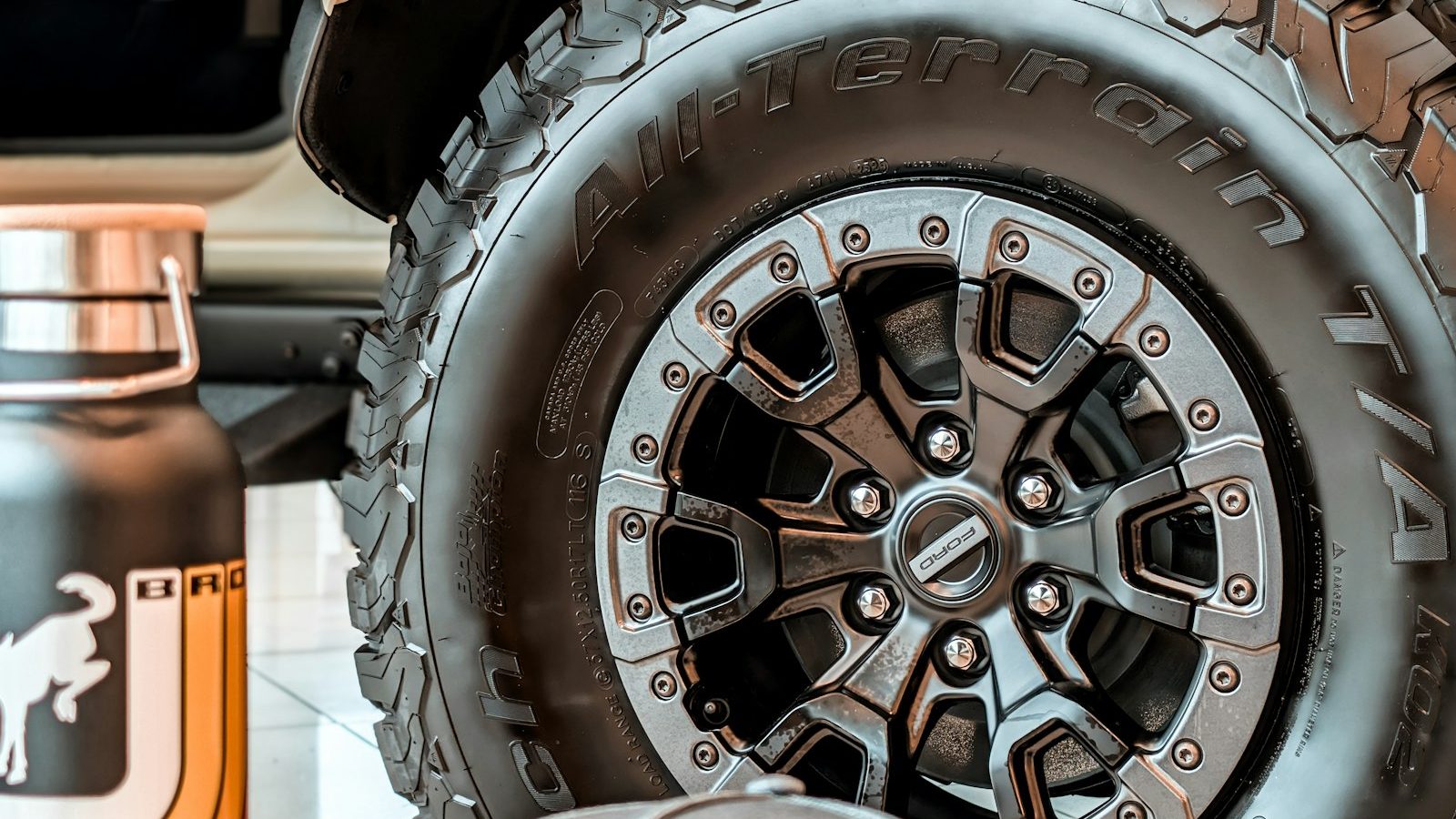
Near the bead you'll find a line like "MAX LOAD 3195 LBS AT 80 PSI MAX PRESS." That's the most cold air pressure the tire is designed to hold and the load it can carry at that pressure. It is not your everyday pressure.
Your everyday cold pressure comes from the Tire and Loading Information label on the driver's door jamb, or from the owner's manual. NHTSA's guidance is plain on this: use the vehicle maker's number, not the one molded into the tire.
Here's the wrinkle truck owners hit constantly. The placard is written for the original tire. Swap P-metric tires for LT tires and the LT tire generally needs more air to carry the same load, so running it at the old P-metric placard number can leave it underinflated. Toyo's bulletin shows an LT245/75R16 Load Range C needing 50 psi to match what the P245/75R16 carries at 35 psi. The fix is to use the tire maker's load and inflation tables to find the pressure that supports your truck's actual axle loads, then set it cold.
Don't guess on pressure
Never exceed the maximum pressure on the sidewall, and never run less than your loaded axle weights require. Underinflation builds heat, and heat is what destroys tires on the highway. If you've changed tire size or type, get the pressure from the tire manufacturer's load and inflation tables or a tire dealer who uses them. Off-road pressures are a separate subject, covered in our airing-down guide.
Reading the DOT Code and the Four-Digit Date Code
Every tire sold in the US carries a tire identification number (TIN) that starts with "DOT." Under the current federal format, a new tire's TIN runs 13 symbols in three groups:
- Plant code: three symbols identifying the factory. Tires built before April 2025 may carry an older two-symbol plant code, so you'll see both formats on tires in service for years.
- Manufacturer's code: six symbols the maker uses to identify size and other characteristics.
- Date code: the final four digits, week then year. NHTSA's own example: 0308 means the third week of 2008. A code of 2324 means the 23rd week of 2024.
Tires built before 2000 used a three-digit date code. The full TIN only has to be molded onto one sidewall, so if you can't find the date, check the other side.
Rubber ages even when the tread looks fine. Check the date code when you buy tires, when you're shopping a used truck, and before trusting a spare that's hung under the bed for years. There's no federal expiration age, so follow the tire and vehicle manufacturers' replacement guidance. Our used 4x4 inspection checklist includes a tire check.
M+S vs. the Three-Peak Mountain Snowflake
M+S (sometimes M/S) means mud and snow. It's based on tread geometry, meaning the amount and shape of the open groove area, and it involves no traction test at all. Nearly every all-terrain and mud-terrain wears it.
The three-peak mountain snowflake (3PMSF) is a mountain outline with a snowflake inside. A tire earns it by scoring a traction index of at least 110 against a reference tire rated 100 (112 when the 16-inch reference tire is used) in a standardized ASTM acceleration test on medium-packed snow. It doesn't measure braking, cornering or ice grip. Still, it's a measured bar, and it's the symbol to look for if your truck sees real winter.
Some all-terrains carry both symbols. Most mud-terrains carry only M+S.
M+S describes what the tread looks like. The snowflake describes what the tire actually did on snow.
Other Sidewall Markings Worth Knowing
- Ply composition. A line such as "TREAD: 2 POLYESTER + 2 STEEL + 2 NYLON / SIDEWALL: 2 POLYESTER" lists the actual casing materials. Off-road tires that advertise three-ply sidewalls will show it here.
- UTQG grades. Treadwear, traction and temperature grades are a passenger-tire system. Government UTQG ratings don't apply to light truck tires, so most LT tires won't have a treadwear number.
- Max load, single and dual. LT tires spell out both loads in pounds and kilograms, matching the dual load index.
- Direction and "outside" markings. Directional tires have a rotation arrow, and asymmetric tires have a designated outer face. Mount them accordingly.
Shop tip
Photograph the full sidewall of any tire you're considering, small print included. Load index, load range, max pressure and date code are all in that one picture.
A Five-Minute Sidewall Check Before You Buy
- Confirm the format. P-metric, LT-metric or flotation. If your truck tows, hauls or goes off-road regularly, LT is usually the right family.
- Check the load index. It should meet or exceed what your door placard or original tires specify. Use the single-wheel number on a single-rear-wheel truck.
- Check load range and max pressure. Make sure the tire can carry your real loads at a pressure it's rated for, and get the right street pressure from the maker's load tables.
- Read the date code. Old stock is worth asking about.
- Look for the snowflake. If you drive in snow, 3PMSF is a meaningful filter. M+S alone tells you little.
- Do the diameter math. Calculate diameter, compare it to your stock size, and plan for clearance, speedometer correction and gearing before the tires are mounted.
Frequently asked questions
What does 121/118Q mean on a tire?
It's the load index and speed rating. The 121 is the single-wheel load rating, 3,197 lb per tire. The 118 is the dual-wheel rating, 2,910 lb per tire when the tire runs as a pair on a dually axle. The Q is a 99 mph speed rating. On a normal single-rear-wheel pickup, the first number is the one that applies.
Is a 285/70R17 a 33-inch tire?
Close. The math gives 32.7 inches: 285 times 0.70 is 199.5 mm of sidewall, which is 7.85 inches, doubled to 15.71 and added to the 17-inch rim. People round it up to 33. Measured diameter varies by brand and tread depth, so check the manufacturer's listed diameter if clearance is tight.
What does Load Range E mean on a truck tire?
Load Range E is the old 10-ply rating. It describes casing strength and inflation capacity, not an actual count of ten plies. On LT-metric sizes it typically allows up to 80 psi cold, though some sizes list a lower maximum. E-range tires are standard on heavy-duty pickups and common on off-road tires for half-tons.
How can I tell how old my tires are?
Find the DOT code on the sidewall and read the last four digits. The first two are the week and the last two are the year, so 2324 means the 23rd week of 2024. The full code is only required on one side of the tire, so check both sides if you can't find it.
Should I inflate my tires to the max pressure on the sidewall?
No. The sidewall number is the most air the tire can safely hold. Your everyday cold pressure comes from the door-jamb placard or owner's manual. If you've switched tire size or changed from P-metric to LT tires, use the tire maker's load and inflation tables to find the pressure that carries your truck's axle loads.
What's the difference between P and LT tires?
P-metric tires are built to passenger-car standards and must be derated by dividing their load capacity by 1.10 when used on a light truck. LT tires use heavier casings, carry load range letters, and are built for higher pressures and heavier loads, which suits towing, hauling and off-road use. They ride firmer and weigh more.
Sources & further reading 10
- nhtsa.govnhtsa.gov/equipment/tires
- law.cornell.edulaw.cornell.edu/cfr/text/49/574.5
- en.wikipedia.orgen.wikipedia.org/wiki/Tire_code
- tirerack.comtirerack.com/tires/tiretech/techpage.jsp?techid=35
- tirereview.comtirereview.com/tire-types-and-load-capacity/
- toyotires.comtoyotires.com/media/bszlobyw/tsd-12-011_replacing_tires_on_light_trucks.pdf
- tiregrades.comtiregrades.com/learn/tire-load-ranges/
- tirerack.comtirerack.com/upgrade-garage/what-is-the-threepeak-mountain-snowflake-symbol
- tirerack.comtirerack.com/tires/Spec.jsp?tireMake=BFGoodrich&tireModel=Mud-Terrain+T%2FA+KM3
- bfgoodrichtires.combfgoodrichtires.com/auto/tires/bfgoodrich-mud-terrain-t-a-km3
Specs and ratings change between model years and configurations. Confirm numbers for your exact truck in the owner's manual and on the door-jamb labels.